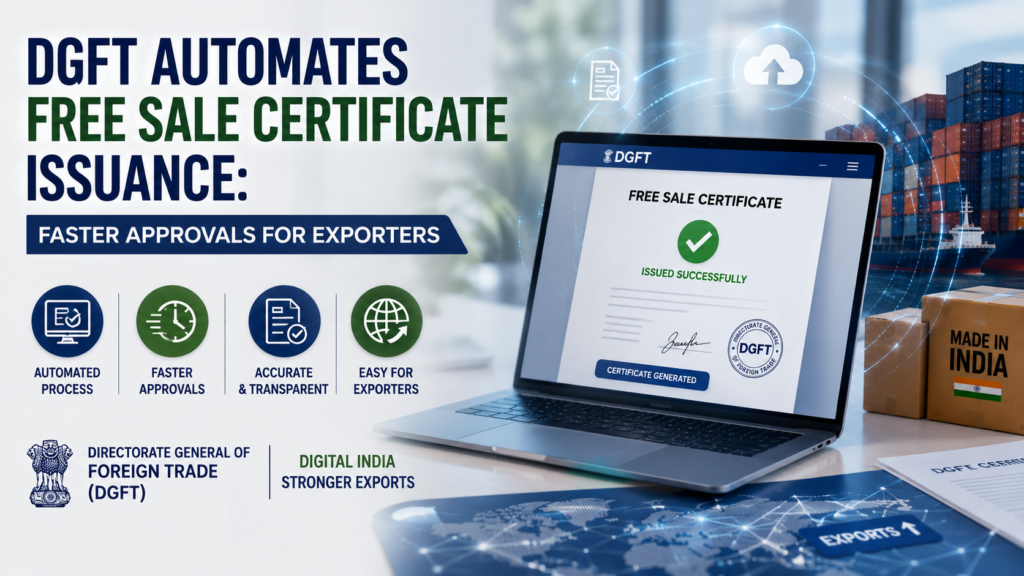
The Directorate General of Foreign Trade (DGFT) has moved to automated issuance of Free Sale and Commerce Certificates (FSC) for eligible applications, removing the mandatory manual scrutiny step that used to slow the process down. The change, notified on 31 August 2026 and announced today, is aimed squarely at cutting processing time and compliance burden for exporters of products outside the Drugs & Cosmetics Act — a category that includes a large share of food, agri and general merchandise exports.
⚡ Quick Facts
- What changed: DGFT now auto-issues eligible Free Sale and Commerce Certificate (FSC) applications, skipping mandatory manual review
- Notification: DGFT Trade Notice No. 24/2026-2027, dated 31 August 2026
- Announced: 1 September 2026, by the Ministry of Commerce and Industry
- Who it covers: Products not covered under the Drugs & Cosmetics Act, 1940 (most food, agri, and general export categories)
- What doesn’t change: Applications needing verification, or that don’t meet automated-processing conditions, still go to manual review at the Regional Authority
What Happened?
DGFT has introduced a system-driven, automated workflow for issuing Free Sale and Commerce Certificates, according to Trade Notice No. 24/2026-2027 dated 31 August 2026. Until now, exporters could apply online, but every application was routed to the concerned DGFT Regional Authority for manual analysis, verification and sign-off — a step the notice itself describes as adding substantial processing time.
Under the new system, applications that meet the defined automated-processing parameters will be issued directly without that manual scrutiny step. The Ministry has framed this as a shift from a manual, RA-dependent process to a paperless, system-driven one, with the explicit goal of shorter and more predictable turnaround times.
Importantly, this isn’t a blanket removal of oversight. Applications that require additional verification, or fall outside the parameters set for automated processing, will continue to be routed to the Regional Authority as before. DGFT has also retained a risk-management layer — some applications approved automatically can still be flagged for review after the fact if they’re picked up under this system.
Why It Matters
Free Sale Certificates are one of those unglamorous but genuinely load-bearing pieces of export documentation. Many importing countries require proof that a product is freely sold and legally marketed in its country of origin before allowing it into their market — and for exporters of food ingredients, nutraceuticals, cosmetics-adjacent products and general merchandise (anything outside the Drugs & Cosmetics Act), the FSC is often exactly that proof.
Every extra week spent waiting on a manually-processed certificate is a week a shipment or a buyer contract can stall. For exporters running on tight buyer timelines — especially smaller and mid-sized exporters without dedicated compliance teams — a faster, more predictable FSC turnaround removes a genuine friction point, not just a paperwork inconvenience.
This also fits a broader pattern DGFT has been pushing this year: reducing manual intervention across trade documentation to make compliance faster without removing it entirely. The retained risk-management flagging shows the intent is speed with continued oversight, not deregulation.
🇮🇳 Impact on Indian Exporters
- If your product falls outside the Drugs & Cosmetics Act — most food ingredients, agri commodities, and general merchandise — your next FSC application may clear without the manual review delay that exporters have dealt with for years
- Faster FSC turnaround directly helps meet buyer-side documentation deadlines, particularly useful when a new export market requires this certificate before customs clearance
- Applications with any ambiguity (product classification, prior compliance flags, incomplete documentation) will still route to manual review — clean, complete applications are more likely to benefit from the faster path
- Worth checking with your CHA or compliance team whether your specific product category and application history meet the “automated processing parameters” DGFT has defined, since these details weren’t fully public at time of writing
🌍 Impact on Global Buyers
- Faster FSC issuance on the Indian side means fewer supplier-side documentation delays holding up shipments — a small but real reliability improvement for buyers sourcing from India
- Buyers requiring FSC as part of import compliance (common for food, nutraceutical and general merchandise categories) may see more predictable lead times from Indian suppliers going forward
- This is a process change, not a change to certification standards — the underlying requirements for what qualifies as “freely sold” in India remain the same, so due diligence on supplier legitimacy is still necessary
Opportunities and Risks
Opportunity: Exporters who’ve historically found FSC processing to be a bottleneck now have a concrete reason to revisit their documentation practices — clean, well-prepared applications are the ones most likely to benefit from the automated path rather than getting bounced to manual review anyway.
Risk: The exact automated-processing parameters DGFT is using haven’t been fully detailed publicly yet. Exporters shouldn’t assume automatic approval as a given — treat this as a potential speed-up to plan around, not a guarantee, until you’ve tested it with an actual application or confirmed specifics with your CHA.
Practical Takeaway
If FSC is part of your regular export documentation, it’s worth submitting your next application with extra attention to completeness and accuracy — that’s the profile most likely to clear through the new automated path. If you’re unsure whether your product category and compliance history qualify, a quick check with your customs house agent before applying can save a redundant back-and-forth.
Trade Research Desk, Seabridge Exports Published:
1 September 2026 | Last Updated: 1 September 2026 This article is for informational purposes only and does not constitute legal, customs, or trade advisory. Please consult your CHA or trade consultant before acting on any export/import decision.