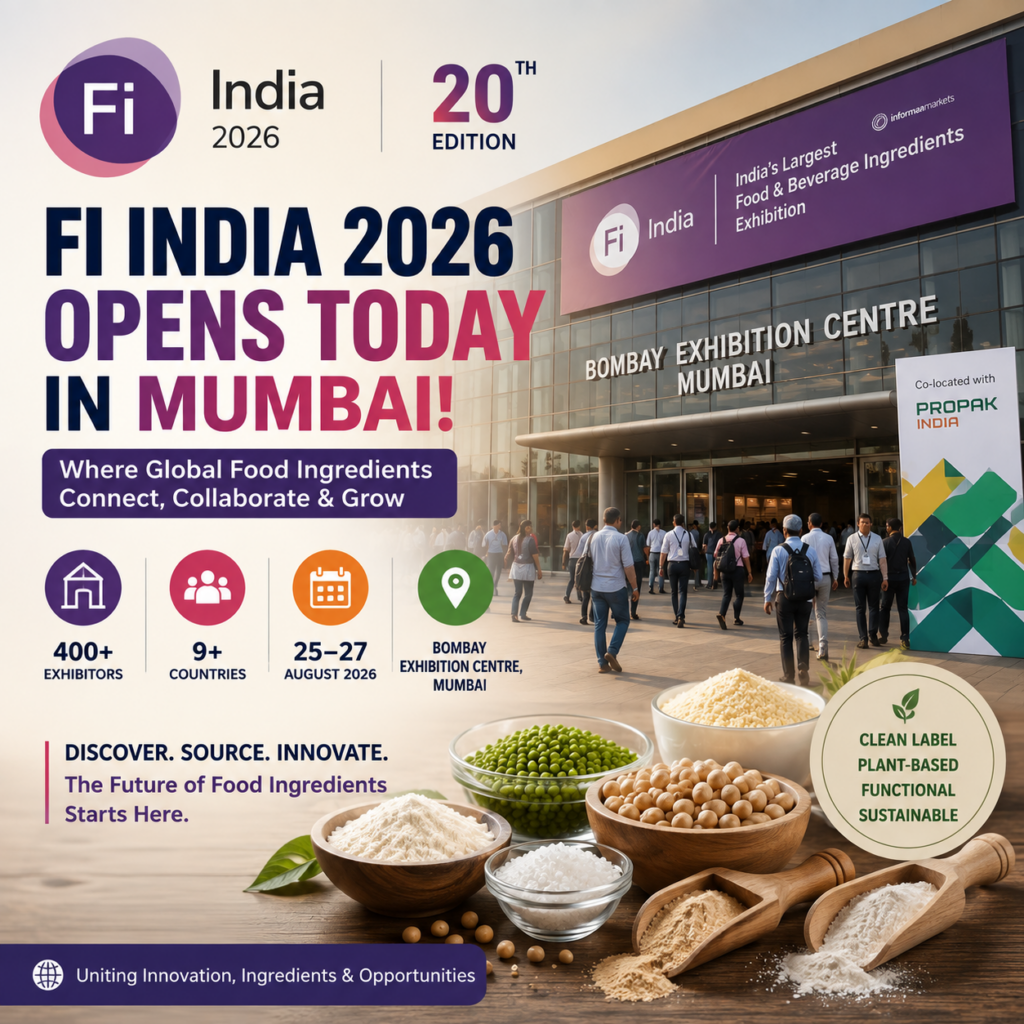
Fi India 2026 — India’s largest dedicated food and beverage ingredients exhibition — opened today at the Bombay Exhibition Centre, Mumbai, marking its 20th edition. Running alongside ProPak India, the three-day show brings 400+ exhibitors and buyers from nine-plus countries under one roof, right as global demand shifts toward clean-label, plant-based and functional ingredients. For Indian exporters and international buyers alike, this week is a live snapshot of where the sourcing conversation is heading.
⚡ Quick Facts
- Event: Fi India 2026 (20th edition), co-located with ProPak India (8th edition)
- Dates: 26–28 August 2026
- Venue: Hall 3 & 4, Bombay Exhibition Centre (BEC), Mumbai
- Scale: 400+ exhibitors, 1,200+ brands, 15,000+ trade visitors expected
- International visitor base: Singapore, Thailand, China, Vietnam, USA, Poland, Japan, Hong Kong, Taiwan
What Happened?
Fi India, the country’s only dedicated B2B platform for food and beverage ingredients, opened its 20th edition today in Mumbai. The show is co-located with the 8th edition of ProPak India, combining ingredient sourcing with processing and packaging technology under a single event umbrella at BEC’s Hall 3 and 4.
The exhibition floor spans food and flavours, natural ingredients, nutraceuticals, proteins, dairy, sweeteners and biotics, drawing visitors from bakery, beverage, dairy, sports nutrition, functional foods and ready-meal segments. Exhibitors on the floor include established names like KP Manish Global Ingredients, Brenntag Ingredients India, Azelis India, IMCD India and Godrej Industries, alongside a long tail of smaller domestic and regional suppliers. The event carries backing from industry bodies including AFSTI, the Indian Beverage Association, HADSA and AIFPA, and international attendance spans nine-plus countries.
Why It Matters
Two trends make this week worth watching beyond the trade-show calendar. First, global F&B demand is visibly shifting toward clean-label, plant-based and functional/fortified products — the exact categories Fi India is organised around this year. That shift directly favours ingredient categories India is strong in: fibre, natural additives, botanicals and nutraceutical raw materials.
Second, India’s food processing and ingredient export base has been getting policy tailwind through schemes like the PLI (Production Linked Incentive) programme, which is pushing domestic manufacturing capacity and value addition higher. A show of this scale — with international buyers physically present rather than sourcing remotely — is a concentrated signal of where that capacity is finding demand.
For a business like Seabridge, this isn’t abstract industry news — it’s the exact ecosystem psyllium husk and other fibre/functional ingredients sit inside.
🇮🇳 Impact on Indian Exporters
- Access to 15,000+ trade visitors and buyers from nine-plus countries in one physical location — a rare concentration versus scattered outreach
- Direct visibility into what multinational ingredient distributors (Brenntag, Azelis, IMCD) are positioning as trending this year, useful competitive intelligence even without a stall
- Nutraceutical and functional-food buyer segments at the show are a natural fit for fibre-based exports like psyllium husk — worth tracking which exhibitors and sessions draw the most buyer interest
- Smaller exporters without a booth can still benefit by timing outreach, LinkedIn content and buyer emails to this week, when ingredient sourcing is top-of-mind industry-wide
🌍 Impact on Global Buyers
- A single-location opportunity to vet Indian suppliers face-to-face on quality, capacity and compliance before committing to contracts
- Useful moment for supply chain diversification — buyers reducing dependence on any single sourcing origin can assess Indian alternatives directly against the international exhibitors also present
- High exhibitor density means buyers should arrive with a shortlist and specific questions on MOQs, certifications and lead times rather than browsing broadly
- Categories like clean-label and plant-based ingredients are well represented this year, making it efficient for buyers with those sourcing briefs specifically
Opportunities and Risks
Opportunity: Trade show weeks create a measurable spike in industry search interest and buyer conversations — even exporters not physically present can capture some of that attention with well-timed content, outreach, and site updates this week rather than a generic monthly cadence.
Risk: With 400+ exhibitors competing for the same 15,000 visitors, standing out on the floor is genuinely hard, and leads generated at large shows have a well-known tendency to go cold without fast, structured follow-up. Exporters relying on this event for pipeline should have a follow-up sequence ready before the show ends, not after.
Practical Takeaway
Whether or not you have a stall at BEC this week, treat 26–28 August as a natural trigger point: align buyer outreach, LinkedIn/social content, and any pending website updates to this window, since ingredient sourcing is unusually front-of-mind across the industry right now. If you’re attending as a buyer, come with a specific shortlist and documentation questions ready — the value of a show this size comes from efficient, targeted conversations, not general browsing.