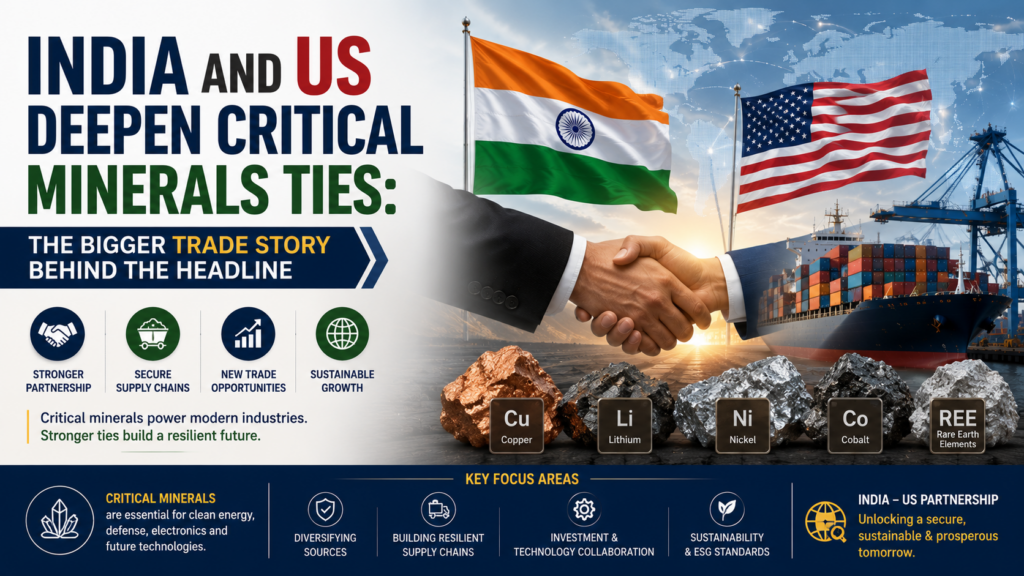
In 60 seconds: Finance Minister Nirmala Sitharaman and US Treasury Secretary Scott Bessent met on the sidelines of the G20 Finance Ministers meeting and committed to deepening India-US cooperation on critical minerals, with a follow-up visit to New Delhi planned later this year. The meeting itself was a short diplomatic readout without new deal terms — but it sits on top of a much bigger, genuinely consequential story: India’s fast-moving push to become a serious player in a supply chain China has dominated for decades.
⚡ Quick Facts
- Meeting: Sitharaman and Bessent, on the sidelines of the G20 FMCBG Meeting, Asheville, North Carolina, 31 August 2026
- Outcome: Commitment to deepen cooperation on critical minerals; Bessent invited to New Delhi later this year for an “Economic & Financial Partnership” dialogue
- Context cited: India’s participation in G7-led critical mineral dialogues on supply chain security
- Global backdrop: China controls roughly 90% of global rare earth processing and magnet manufacturing capacity
- India’s response: ₹16,300 crore National Critical Mineral Mission, ₹7,280 crore rare earth magnet manufacturing scheme, and dedicated mineral corridors across four states

What Happened?
Sitharaman and Bessent met on the sidelines of the G20 Finance Ministers and Central Bank Governors meeting in Asheville, North Carolina, where the two acknowledged the long-standing India-US relationship and agreed to deepen cooperation across several areas, critical minerals among them. Bessent specifically welcomed India’s participation in G7-led critical mineral dialogues focused on securing supply chains and sharing research and technology, and Sitharaman invited him to New Delhi later this year for a dedicated Economic & Financial Partnership dialogue.
It’s worth being direct about scope here: this was a short diplomatic statement, not an agreement with specific commitments, timelines or numbers attached. The real substance to watch is what comes out of that planned New Delhi visit.
Why It Matters
The reason this modest meeting is generating so much coverage is the backdrop it sits against. China currently controls close to 90% of global rare earth processing and permanent magnet manufacturing, and roughly 60% of mining — a concentration that became a live global risk when China tightened export controls on key rare earth elements starting in 2025. Industries dependent on these materials — electric vehicles, wind turbines, defence electronics, consumer electronics — got a direct reminder of how exposed they were to a single-country chokepoint.
India has responded with unusual speed for a multi-year industrial strategy. Since late 2025, the government has approved a ₹7,280 crore Rare Earth Permanent Magnet manufacturing scheme, announced dedicated Rare Earth Corridors across Odisha, Kerala, Andhra Pradesh and Tamil Nadu, cut import duty on monazite (a key rare earth source ore) to zero, and backed the broader National Critical Mineral Mission with over ₹16,300 crore in direct spending. On the international side, India’s state-run KABIL has signed overseas mineral deals — including lithium exploration blocks in Argentina — and India is a member of the Minerals Security Partnership, a grouping of major economies coordinating on supply chain diversification.
Today’s Sitharaman-Bessent meeting is best read as one data point in that larger alignment: the US, like other G7 economies, is actively courting India as a partner in de-risking critical mineral supply chains away from China. That’s a genuinely significant multi-year trend — even though this particular meeting didn’t produce new deal terms.
🇮🇳 Impact on Indian Exporters
- Most Indian exporters won’t feel direct impact from this specific meeting — India’s rare earth processing capacity is still in early build-out, not yet at export scale
- Exporters and manufacturers in EV components, defence electronics, renewable energy equipment and allied sectors should treat this as a signal worth tracking closely, since policy and diplomatic momentum in this space is moving faster than the underlying infrastructure
- Businesses located near or connected to the announced mineral corridors (Odisha, Kerala, Andhra Pradesh, Tamil Nadu) may see logistics, processing and ancillary supply opportunities emerge over the next few years as these corridors develop
- The planned New Delhi “Economic & Financial Partnership” visit later this year is the concrete milestone to watch for any specifics that move beyond diplomatic language
🌍 Impact on Global Buyers
- Buyers currently dependent on China for rare earths and critical minerals should note India as an emerging — not yet mature — alternative; capacity constraints mean this is a multi-year diversification play, not an immediate sourcing switch
- The broader G7-aligned push toward supply chain diversification (also involving Australia, Japan, the EU, and now more visibly the US-India track) suggests buyers should expect more announcements in this space through 2026-27, even if today’s specific meeting was light on detail
- International buyers evaluating India for future mineral or magnet sourcing should watch India’s REPM scheme rollout and corridor development timelines rather than diplomatic statements for real signals of capacity coming online
Opportunities and Risks
Opportunity: For businesses positioned in or adjacent to India’s critical minerals build-out — manufacturing, logistics, skilled labour, ancillary chemicals — sustained diplomatic and policy momentum like this meeting tends to precede real investment. Early positioning near the announced corridors could pay off over a multi-year horizon.
Risk: There’s a real gap between diplomatic momentum and delivered capacity in this space right now — India’s processing infrastructure is still nascent, and readouts like today’s meeting can create an impression of progress that outpaces what’s actually deployable. Businesses should avoid treating this specific news as an immediate trade signal and instead watch for concrete scheme rollouts, corridor completions, and the outcomes of the planned New Delhi dialogue.
Practical Takeaway
For most exporters, today’s meeting doesn’t require any immediate action — it’s a diplomatic signal, not a policy change. If your business touches EV components, defence electronics, renewable energy manufacturing, or sits near the announced mineral corridor states, it’s worth bookmarking this story and watching for the New Delhi “Economic & Financial Partnership” visit later this year, which is where actual specifics are more likely to emerge.
Trade Research Desk, Seabridge Exports Published:
1 September 2026 | Last Updated: 1 September 2026 This article is for informational purposes only and does not constitute legal, customs, or trade advisory. Please consult your CHA or trade consultant before acting on any export/import decision.