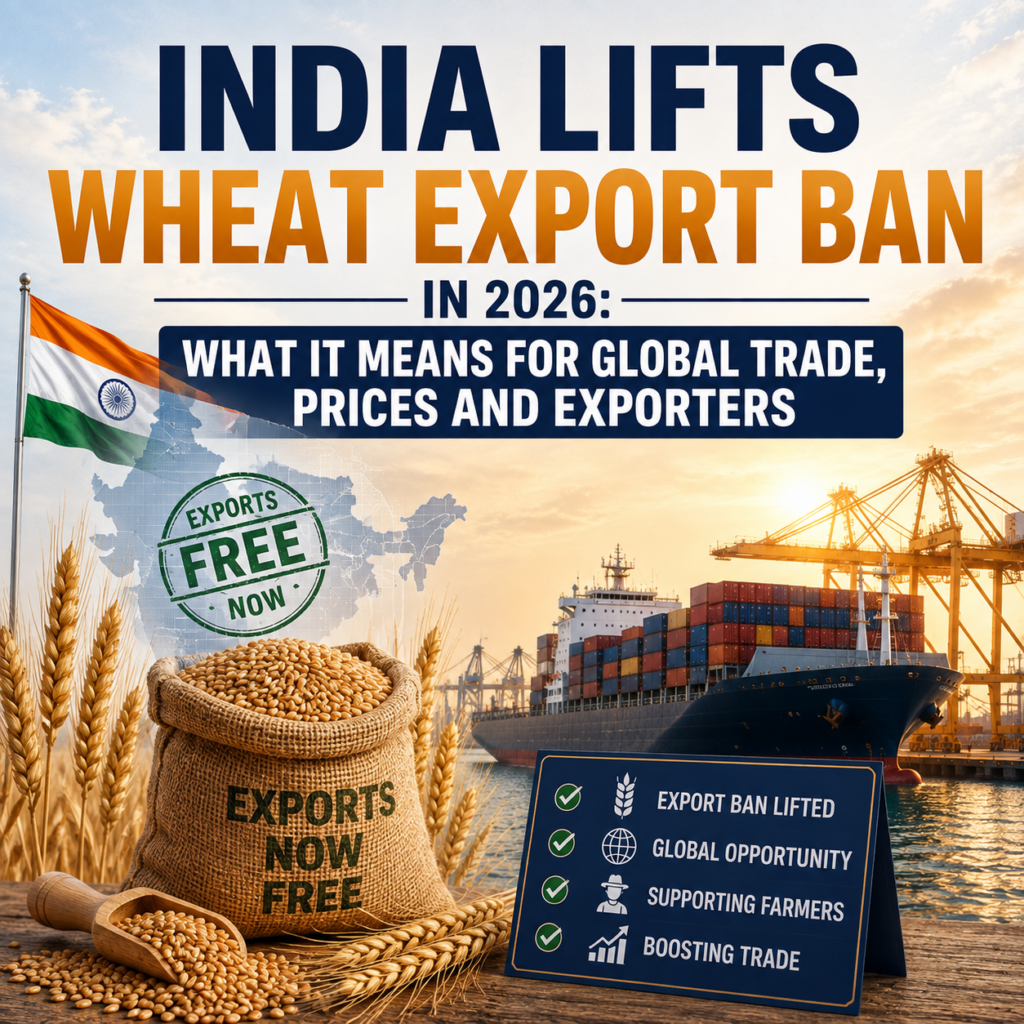
India Lifts Its 4-Year Wheat Export Ban: What It Means for Exporters and Global Buyers
In 60 seconds: India has scrapped its four-year-old ban on wheat exports, moving wheat, durum, flour, maida, semolina and atta from “prohibited” to “free” export category with immediate effect. The move comes as record domestic stocks meet a global supply crunch triggered by escalating Black Sea disruptions — creating a fresh window for Indian exporters just as buyers scramble for alternatives.
⚡ Quick Facts
- What: DGFT notification, issued 24 August 2026, lifts India’s wheat export ban effective immediately
- Covered: Wheat, durum wheat, wheat flour, maida, semolina, wholemeal atta, resultant atta
- Ban duration: In place since May 2022 — over four years
- Why now: Record 2025–26 wheat output (~120.65 million tonnes, +2.3% YoY) and record domestic stockpiles
- Global backdrop: Chicago wheat futures up 17%+ since July 2026 on Black Sea supply disruption

What Happened?
The Directorate General of Foreign Trade (DGFT) issued notifications on 24 August 2026 shifting wheat and its key by-products — durum wheat, flour, maida, semolina, wholemeal atta and resultant atta — from the “prohibited” export category to “free,” with the change taking effect immediately.
This ends a ban that had stood since May 2022, when the government restricted wheat shipments over food security concerns following a heatwave-hit harvest and Russia-Ukraine war disruption. A partial easing had already begun in February 2026 with limited government-monitored shipments; this latest notification removes the restriction entirely.
Officials cited a straightforward rationale: India is sitting on a record harvest and unusually large buffer stocks, while domestic wheat prices have stayed weak enough to hurt farmer incomes. Allowing exports is expected to lift local prices modestly, support farmer earnings, and encourage strong sowing ahead of the next season. The country’s food and public distribution secretary confirmed that low domestic prices, not a shortage, are driving the decision.
Why It Matters
The timing is what makes this significant. Global wheat markets are already under strain: escalating attacks between Russia and Ukraine have disrupted Black Sea shipping routes, which together handle a large share of world wheat trade. That disruption pushed Chicago wheat futures up more than 17% between early July and late August 2026, touching two-year highs.
India re-entering the export market — as one of the world’s largest wheat producers, with USDA forecasting record domestic stockpiles by the end of the 2026–27 season — gives global buyers a credible alternative supply source at a moment when established routes are unreliable. For a market watching every signal out of the Black Sea, this is genuine news, not a minor policy footnote.
🇮🇳 Impact on Indian Exporters
- Wheat, flour, maida, semolina and atta exporters can now ship without special permission, opening a market that’s been closed for over four years
- Logistics and pricing favor nearby markets first — Bangladesh, Nepal, Bhutan and Southeast Asia — due to freight advantages over competing origins
- Wheat products like atta are expected to see strong demand from the Indian diaspora in the Middle East and Southeast Asia
- Exporters should track DGFT for any quantity caps or a government-monitored allocation system, as India has used such mechanisms during earlier partial openings
🌍 Impact on Global Buyers
- A new, large-volume origin re-enters the market just as Black Sea supply reliability is in question — useful for diversifying sourcing risk
- Indian wheat pricing will likely track domestic MSP dynamics as much as export demand, so buyers should expect price discovery to take a few weeks to stabilize
- Early movers securing contracts before broader market awareness catches up may find more favorable terms
- Buyers should confirm phytosanitary and quality certification requirements specific to Indian wheat exports, as these can differ from Black Sea origin paperwork
Opportunities and Risks
Opportunity: For agri exporters and trading houses already active in India, this is a rare reopening of a major commodity line at a moment of genuine global demand — not a routine seasonal update. Early entrants who move on documentation and buyer outreach now have a real first-mover window.
Risk: Export policy on food staples in India has changed direction before, often on short notice, when domestic prices or stock levels shift. Exporters and buyers should treat this as the current policy stance, not a permanent guarantee, and build contracts with that volatility in mind.
Practical Takeaway
If you’re an Indian agri exporter — even outside wheat — this notification is a signal worth watching closely: it shows the government is willing to open staple commodity exports quickly when domestic conditions allow. For buyers, it’s a good moment to reach out to Indian suppliers directly rather than waiting for prices to move further on Black Sea headlines. As always with DGFT policy, confirm the latest notification directly before finalizing any contract, since amendments can follow quickly.