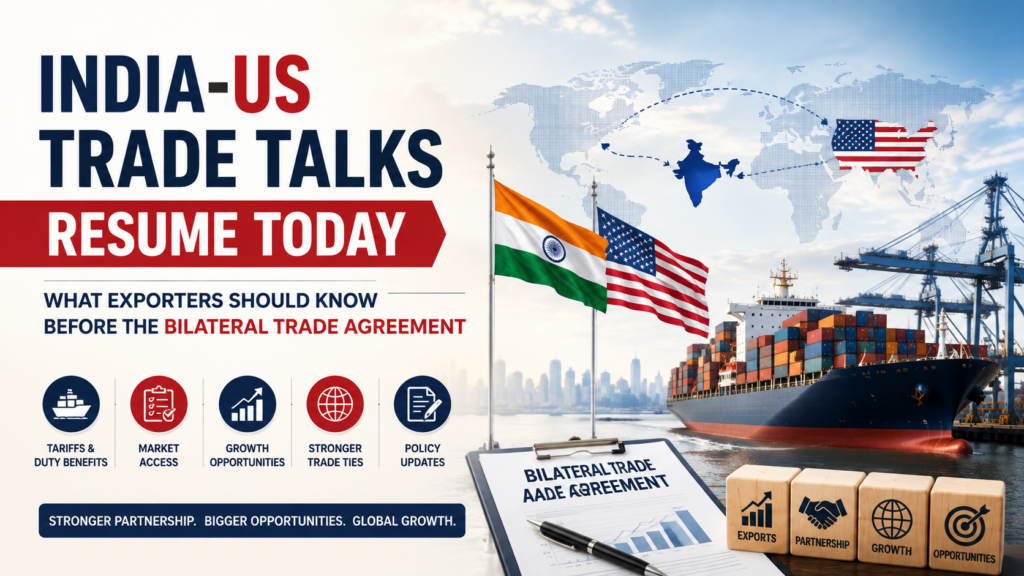
India’s Commerce Ministry met exporters, export promotion councils and industry chambers today to review India-US trade performance and discuss the ongoing Bilateral Trade Agreement (BTA) negotiations. The meeting, chaired by India’s chief BTA negotiator, comes weeks before Commerce Minister Piyush Goyal travels to the US for the G20 Trade Ministerial and direct talks with the US Trade Representative — making this a genuine checkpoint moment for exporters watching where tariffs and market access go next.
⚡ Quick Facts
- Meeting date: 1 September 2026, chaired by Additional Secretary Darpan Jain
- Jain’s role: India’s chief negotiator for the India-US Bilateral Trade Agreement (BTA)
- Participants: CII, FICCI, Assocham, FIEO, and sector representatives from pharma, engineering, textiles, agriculture, chemicals, marine products, leather, automobiles, auto components, handicrafts and plastics
- Next milestone: Goyal’s US visit in late September for the G20 Trade Ministerial in Milwaukee (starting 30 September), plus bilateral talks with USTR Jamieson Greer
- Current tariff backdrop: US reciprocal tariff on Indian goods stands at roughly 18%, down from a peak of 50%, following the February 2026 Interim Trade Agreement
What Happened?
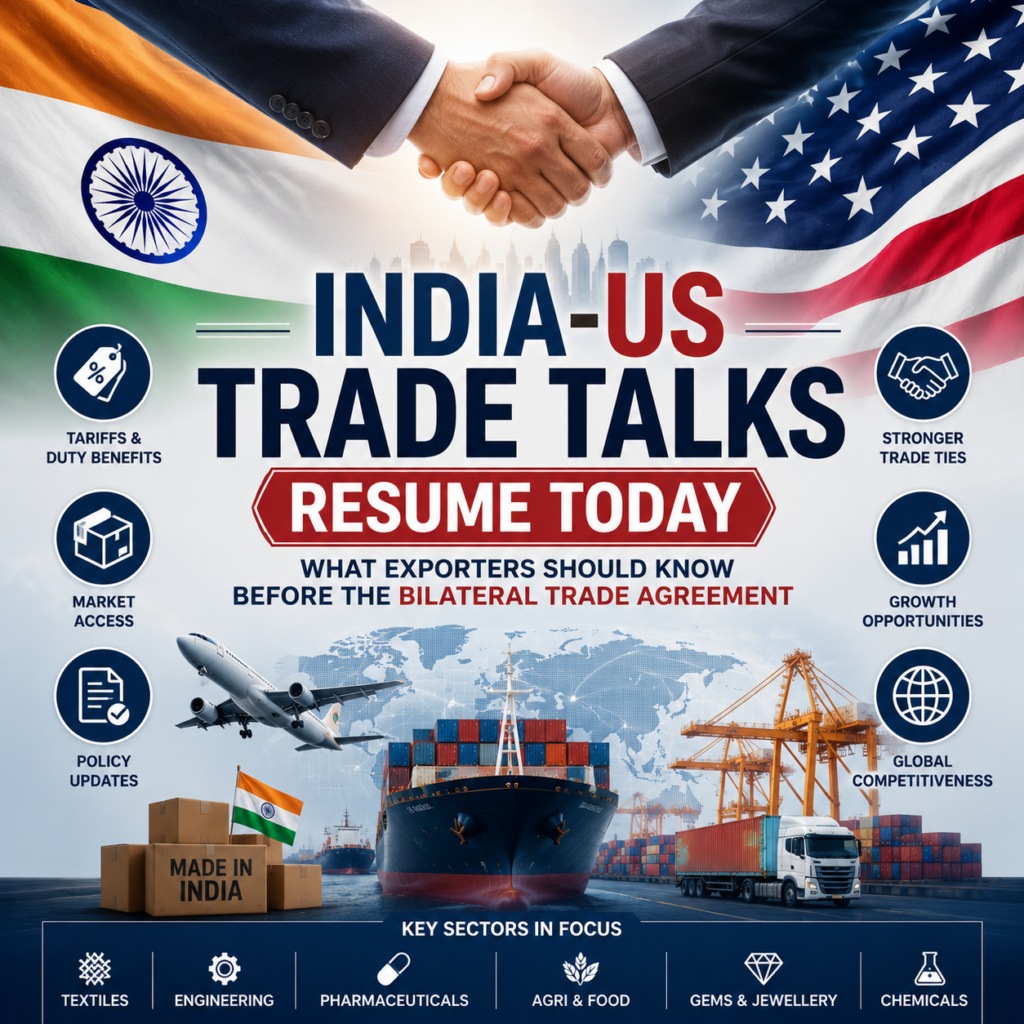
India’s Commerce Ministry convened exporters, export promotion councils and industry chambers today to take stock of India-US trade performance and sector-wise developments as negotiations toward a comprehensive Bilateral Trade Agreement continue. The meeting was chaired by Additional Secretary Darpan Jain, who also serves as India’s chief negotiator for the BTA.
Representatives across a wide sweep of export-heavy sectors joined — pharmaceuticals, engineering goods, textiles, agriculture, chemicals, marine products, leather, automobiles, auto components, handicrafts and plastics — alongside the country’s major industry bodies: CII, FICCI, Assocham and FIEO. The discussion centered on recent trade trends, how individual sectors are performing under the current tariff regime, and the practical issues exporters want addressed as the BTA moves toward finalization.
The timing isn’t incidental. Goyal is scheduled to travel to the US in late September to attend the two-day G20 Trade Ministerial in Milwaukee, which begins 30 September, and to hold direct bilateral talks with US Trade Representative Jamieson Greer. Today’s meeting functions as India’s internal alignment step before that higher-level round.
Why It Matters
This sits on top of a genuinely volatile 18 months of India-US tariff history. The US imposed a 26% reciprocal tariff on Indian goods in April 2025, which escalated further with an additional 25% penalty tied to India’s Russian oil purchases — pushing the combined effective tariff to 50% by late August 2025, among the highest the US applied to any major trading partner.
That changed with the February 2026 Interim Trade Agreement, which cut the reciprocal tariff to 18% and removed the Russia-linked penalty tariff entirely, in exchange for India committing to reduce duties on a range of US industrial and agricultural goods and to purchase over $500 billion in US energy, technology and other products over five years. Notably, India kept dairy, a broad range of spices, select grains like rice and wheat, and certain frozen or preserved vegetables outside the scope of that tariff reduction — a detail worth remembering for agri exporters specifically.
The Interim Agreement was always framed as a bridge to a fuller BTA, not the final word. Today’s meeting, and the run-up to the G20 Trade Ministerial, is where that fuller agreement gets shaped — covering non-tariff barriers, market access details, and sector-specific terms that the interim deal left open. For exporters, the direction these talks take over the next month has more practical weight than most single news cycles this year.
🇮🇳 Impact on Indian Exporters
- The 18% tariff (versus the earlier 50%) is currently the operating baseline — but it isn’t guaranteed to be final until the BTA is signed, so contracts and pricing built on today’s rate carry some forward-looking risk
- Sectors named in today’s meeting — pharma, textiles, marine products, engineering, auto components — are the ones most likely to see sector-specific movement in the coming BTA text; exporters in these categories should watch for direct outreach from FIEO or their sector’s export promotion council
- Agri exporters should note that dairy, spices, and select grains were excluded from India’s tariff-reduction commitments under the interim deal — this carve-out may or may not extend into the final BTA, so it’s worth tracking specifically rather than assuming stability
- The $500 billion purchase commitment India has made to the US (energy, tech, aircraft parts, coking coal) is a large enough number that it may shape broader trade sentiment and rupee-dollar dynamics over the coming years — relevant context for anyone pricing long-term USD contracts
🌍 Impact on Global Buyers
- Buyers sourcing from India for the US market should treat current landed costs as provisional; a finalized BTA later this year could shift effective tariffs again, in either direction depending on sector
- US buyers specifically should note India’s carve-outs (dairy, spices, select grains) remain higher-duty categories for now, which affects cost comparisons against other origins for those product lines
- The broader signal — India and the US actively negotiating rather than escalating — reduces near-term disruption risk for buyers who had diversified away from India during the 2025 tariff spike, and may make India a more attractive re-entry option
- Buyers should watch the 30 September G20 Trade Ministerial and the Goyal-Greer bilateral as the next concrete checkpoint, rather than expecting resolution before then
Opportunities and Risks
Opportunity: Exporters in the sectors directly represented at today’s meeting have a live channel to flag specific pain points before the BTA text is finalized — through FIEO, CII, FICCI or Assocham. That’s a meaningfully open window compared to reacting after an agreement is signed.
Risk: The most likely failure mode here isn’t a bad deal — it’s exporters assuming the current 18% rate and existing carve-outs are permanent when they’re explicitly still under negotiation. Anyone pricing multi-month or multi-year US contracts right now should build in a tariff-revision clause or reassessment point rather than locking in today’s numbers indefinitely.
Practical Takeaway
If your export business touches the US market — directly or through buyers who resell there — treat the next four weeks as an active watch period, not background noise. The concrete date to track is 30 September, when the G20 Trade Ministerial and the Goyal-Greer bilateral take place. Until then, avoid long-term US-bound contracts priced on the assumption that today’s 18% tariff and current product carve-outs are locked in.
Sources
- SiliconIndia — India-US Trade Talks Gain Focus Ahead of September 1 Meeting
- Business Standard — Commerce Ministry Meeting Industry, Exporters on India-US Trade on Sept 1
- India Briefing — US-India Strike Interim Trade Deal, Cut Tariffs to 18%
- UNESCAP — India-US Bilateral Trade Agreement and Implications for South Asia