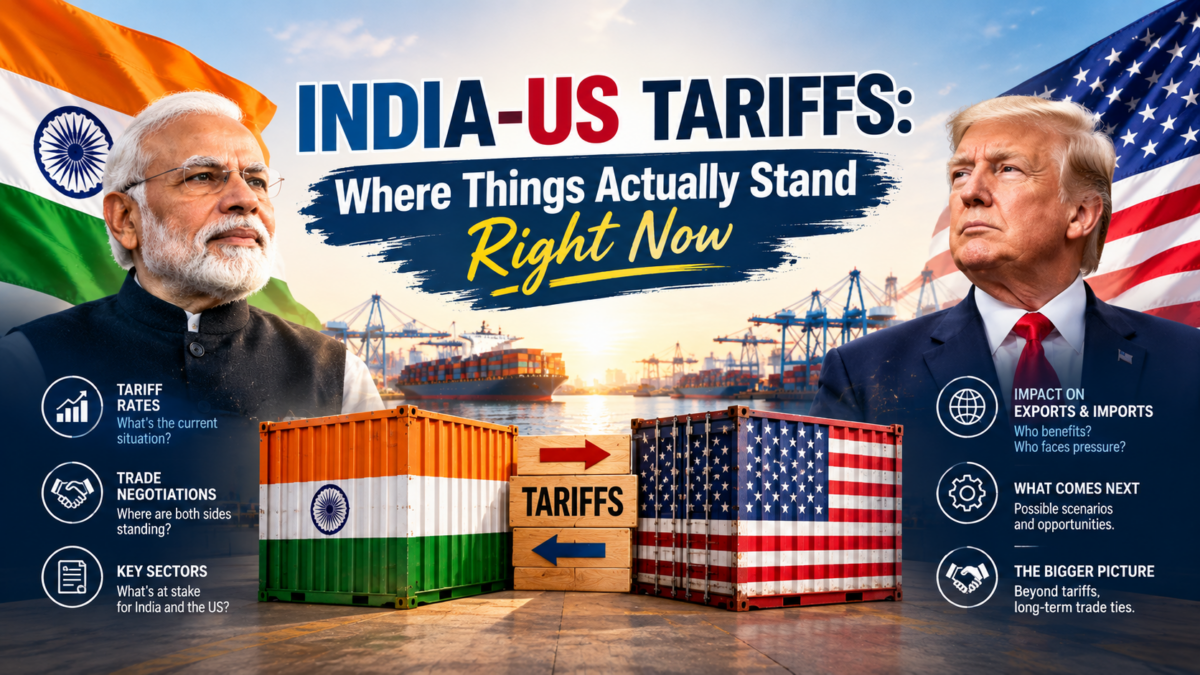
In 60 seconds: India’s exports to the US currently face an 18% tariff under the February 2026 Interim Trade Agreement — down sharply from a peak of 50% last year — but the comprehensive Bilateral Trade Agreement (BTA) that would lock this in remains unsigned. Commerce Minister Piyush Goyal has said India won’t announce final BTA details until Washington offers a genuinely preferential rate compared to competing exporters like Vietnam and Bangladesh, and a fresh Section 301 investigation into forced-labor practices adds a new layer of uncertainty on top. The next real checkpoint is the G20 Trade Ministerial in Milwaukee starting 30 September.
⚡ Quick Facts
- Current effective tariff: 18% reciprocal tariff on most Indian goods, in place since 7 February 2026
- Down from: A peak of 50% (25% reciprocal + 25% Russia-oil-linked penalty), which applied through most of late 2025
- Latest ministerial statement: 3 September 2026 — Goyal says India will finalise BTA details only once the US offers preferential terms over India’s competitors
- Pre-BTA review meeting: 1 September 2026 — Commerce Ministry met CII, FICCI, FIEO, Assocham and sector exporters
- Next major checkpoint: G20 Trade Ministerial, Milwaukee, starting 30 September 2026 — expected Goyal-Greer bilateral
What’s the Current Status?
Here’s the timeline that gets you to today. In August 2025, the US imposed a 25% reciprocal tariff on Indian goods, then added a further 25% penalty tied to India’s continued purchases of Russian oil — pushing the combined tariff to 50%, among the highest the US applied to any major economy. That changed on 6-7 February 2026, when India and the US signed a joint statement establishing an Interim Trade Agreement: the US cut the reciprocal tariff to 18% and fully removed the Russia-linked penalty, in exchange for India eliminating or reducing tariffs on a wide range of US industrial and agricultural goods and committing to purchase over $500 billion in US products over five years.
That interim deal was always framed as phase one — a bridge to a fuller, comprehensive BTA covering market access, non-tariff barriers, digital trade and supply chain provisions. Since February, that fuller agreement has been in a holding pattern. Progress reports in June suggested the two sides were “99% finalized” before India pulled back over sticking points. By July, one detailed analysis described the BTA as genuinely stalled amid conflicting domestic priorities and fresh American tariff investigations.
Two developments this month bring the picture up to date. On 1 September, India’s Commerce Ministry — led by chief BTA negotiator Darpan Jain — met with major industry chambers and sector exporters to review trade performance ahead of the next negotiating push. Then on 3 September, Goyal stated plainly that India will only announce final BTA details once Washington agrees to give India preferential tariff terms relative to its competitors — meaning India isn’t simply seeking to lock in today’s 18% rate, but a rate meaningfully better than what Vietnam, Bangladesh or other competing exporters receive.
Layered on top of this is a newer complication: US trade authorities have reportedly proposed Section 301 tariffs tied to forced-labor concerns across roughly 54 countries, India included, as a potential parallel or replacement mechanism to existing tariff structures. This hasn’t been finalized, but it’s a live variable that didn’t exist even a few weeks ago.

Why It Matters
The core tension here is straightforward: India has functional, workable terms right now (18%, well below last year’s 50%), but is deliberately holding out for something better rather than accepting the interim rate as final. That’s a real negotiating stance, not just delay — Goyal’s comment about wanting preferential terms over competitors is specific and consequential. If India succeeds, exporters could see rates drop further, or gain a structural edge over Vietnam and Bangladesh in the US market. If talks drag on without resolution, the 18% rate remains merely provisional, not contractually locked in — and provisional rates can, in principle, move in either direction.
The forced-labor Section 301 angle adds a genuinely new risk dimension that’s separate from the reciprocal tariff conversation entirely. It’s a different legal mechanism, tied to labor practice concerns rather than trade balance or geopolitics, and it’s worth tracking independently rather than assuming it’s folded into the BTA talks.
Meanwhile, India’s actual export performance is already showing the benefit of the current reduced-tariff environment — August 2026 trade data released this month showed overall exports up over 25% year-on-year, with sectors like electronics and engineering goods posting particularly strong growth. That’s real evidence the 18% rate, even without a finalized BTA, is already working better for Indian exporters than the 50% environment did.
🇮🇳 Impact on Indian Exporters
- The 18% rate is your current operating reality — but treat it as the floor of a negotiation, not a locked-in ceiling; Goyal’s own statements suggest India is pushing for something better, not just holding the line
- Sectors named in the 1 September review — pharma, textiles, marine products, engineering, auto components — are the ones most likely to see direct movement whenever the final BTA text lands
- If your business or your buyers involve labor-intensive manufacturing (textiles, leather, apparel), keep an independent eye on the Section 301 forced-labor tariff track — it moves on its own timeline and criteria, separate from the reciprocal tariff story
- Contracts priced on the assumption that 18% is final and permanent carry real risk; build in a reassessment point around the 30 September G20 Trade Ministerial rather than locking in long-term US-bound pricing today
🌍 Impact on Global Buyers
- US buyers sourcing from India are currently paying costs reflective of the 18% tariff environment — a meaningful improvement from the 50% period, but still not the final, settled number
- If India successfully negotiates preferential terms over Vietnam and Bangladesh, Indian-origin goods could become comparatively more attractive to US buyers weighing multiple sourcing origins — worth watching if you’re actively comparing suppliers across these countries
- Buyers in labor-intensive categories (textiles, apparel, leather) should track the Section 301 forced-labor investigation independently, since it could affect landed costs regardless of how the broader BTA resolves
- The 30 September G20 Trade Ministerial is the concrete date to watch for any material movement — expect continued uncertainty until then
Opportunities and Risks
Opportunity: India’s public negotiating position — holding out for preferential terms rather than settling — signals confidence that current export momentum (reflected in August’s strong trade numbers) gives it leverage. If that strategy succeeds, exporters could see a genuinely better outcome than simply preserving the 18% status quo.
Risk: Two live, independent uncertainties are stacked on top of each other right now: whether the BTA concludes with better, worse, or unchanged terms, and whether the Section 301 forced-labor tariff track adds a new cost layer regardless of BTA outcomes. Businesses that treat this as a single, settled story risk being caught off guard by whichever track moves first.
Practical Takeaway
If you export to the US, don’t treat the current 18% tariff as a stable, long-term planning assumption — it’s the product of an interim agreement still awaiting its comprehensive successor, and India’s own commerce minister has said as much publicly. Mark 30 September on your calendar as the next real checkpoint, and if your product falls into a labor-intensive category, track the Section 301 forced-labor tariff proposal separately from the main BTA story, since it operates on its own track.
Trade Research Desk, Seabridge Exports Published:
18 September 2026 | Last Updated: 18September 2026. This article is for informational purposes only and does not constitute legal, customs, or trade advisory. Please consult your CHA or trade consultant before acting on any export/import decision.