Everything you need, right where you are

  • Ahmedabad, India
  • +91 99784 44291
Categories
Uncategorized

Psyllium Husk Supplier India | Sea Bridge Exports, Unjha

Psyllium Husk Supplier in India: Why We Charge for Samples (And Why Serious Buyers Don’t Mind)

A direct-origin psyllium husk exporter’s honest look at sourcing, quality, and trust — from Unjha, Gujarat, India.

There’s a particular smell in Unjha, Gujarat — India’s psyllium husk processing hub — during peak season: dry, dusty, faintly medicinal. You only understand it once you’ve stood in a processing yard at 6 AM watching trucks unload sacks of raw husk that Indian farmers have been growing since before Sea Bridge Exports existed.

We didn’t start this company knowing psyllium the way we know it now. Nine months ago, as a new psyllium husk exporter from India, it was a line item on a product list — a commodity with a purity percentage and a mesh size, something you quoted and shipped. It took standing in that yard, talking to millers who’ve processed husk for three generations, to understand that we weren’t just exporting a fiber ingredient. We were exporting something that ends up inside a fiber supplement bottle in a US pharmacy, a gluten-free bread mix in Germany, a digestive health sachet in a Gulf pharmacy — carrying a small piece of Gujarat’s soil into someone else’s daily routine, usually without them ever knowing where it came from.

That disconnect is what we think about most.

What International Buyers Should Know About Sourcing Psyllium Husk from India

Here’s something we learned early, the hard way: the global psyllium husk trade runs on trust that’s almost entirely invisible. A buyer in Frankfurt, Chicago, or Dubai places an order based on a Certificate of Analysis (COA), a mesh spec, a purity number — numbers on a page representing husk they haven’t seen, processed by people they’ll never meet, grown in fields they’ll never visit. And on our end, as an Indian psyllium husk manufacturer and exporter, we’re making promises about consistency across a crop that depends on monsoon timing, soil conditions, and a hundred small variables no spec sheet captures.

Most exporters paper over that gap with confident language. We’d rather be honest about it — because the buyers who’ve stuck with us are the ones who appreciated being told the truth about a delayed batch instead of a reassuring lie.
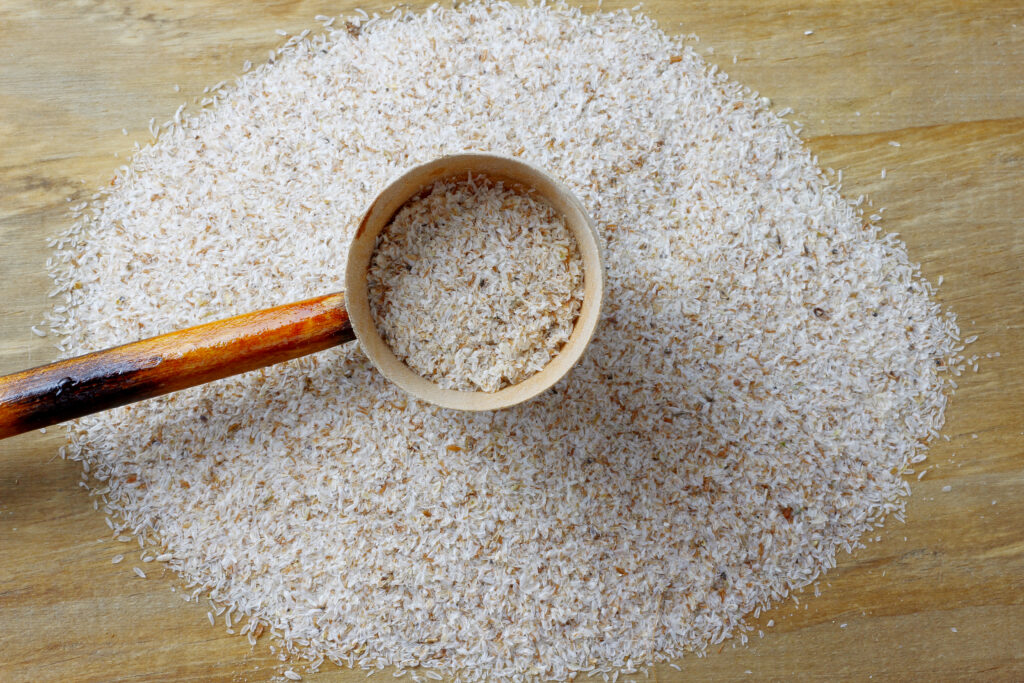
portion of raw psyllium husk over rustic wooden table. top view

Why We Charge for Psyllium Husk Samples

This wasn’t a policy decision made in a boardroom. It came from watching our own sample requests pile up — twenty inquiries a week, most from buyers comparing a dozen psyllium husk suppliers with no real intention of ordering, a few from students, occasionally (we suspect) from competitors. Each one still cost us the same grading, testing, and courier effort as a genuine buyer.

We realized something simple: a free sample tells you nothing about who’s serious. A priced one does. The buyer who pays for a psyllium husk sample tells us their real purity grade, their real market, their real timeline — because they’re not collecting samples, they’re evaluating a future supplier. That’s who we actually want to build with.

What a sample from us includes:

  • The exact purity (95%, 98%, or 99%) and mesh size you specify, drawn from a live processing lot in Unjha — not a display jar
  • A spec sheet stating swelling volume (gel formation index), moisture content, and foreign matter percentage
  • A lot number tying the sample to a specific production batch
  • Our FSSAI and APEDA RCMC registration documents

What we need from a buyer:

  • Purity and mesh size you’re targeting
  • Destination market and end-use application (pharma, nutraceutical, food, or repacking)
  • Indicative monthly volume
  • Your timeline

What We’re Building Toward as an Emerging Indian Exporter

We’re a nine-month-old company. We don’t have the scale of the fifty-year-old trading houses we compete against, and we’re not going to pretend otherwise. What we do have is the chance to build something differently from day one — traceability that isn’t an afterthought, documentation that isn’t recycled from six months ago, and a willingness to say “we don’t have that yet” instead of overpromising.

Our vision isn’t to become the biggest psyllium husk exporter out of Gujarat. It’s to become the one international buyers trust enough to stop comparing us against fourteen others — because we told them the truth often enough that we stopped needing to prove it every time.

That’s a slower way to grow a business. We think it’s the only way that actually lasts.


Looking to Source Psyllium Husk or Powder from India?

Sea Bridge Exports ships premium psyllium husk, psyllium husk powder, psyllium seeds, and Basmati rice directly from Gujarat, India — with full export documentation (Certificate of Analysis, Phytosanitary Certificate, Certificate of Origin) via Mundra and Nhava Sheva ports.

If you’re sourcing psyllium husk for a pharmaceutical formulation, nutraceutical product, functional food line, or export repacking anywhere in the US, UK, Europe, Middle East, or Southeast Asia — get in touch and tell us your grade and market. We’ll quote you a sample.

📧 info@seabridgeexports.com | 🌐 seabridgeexports.com
Categories
Uncategorized

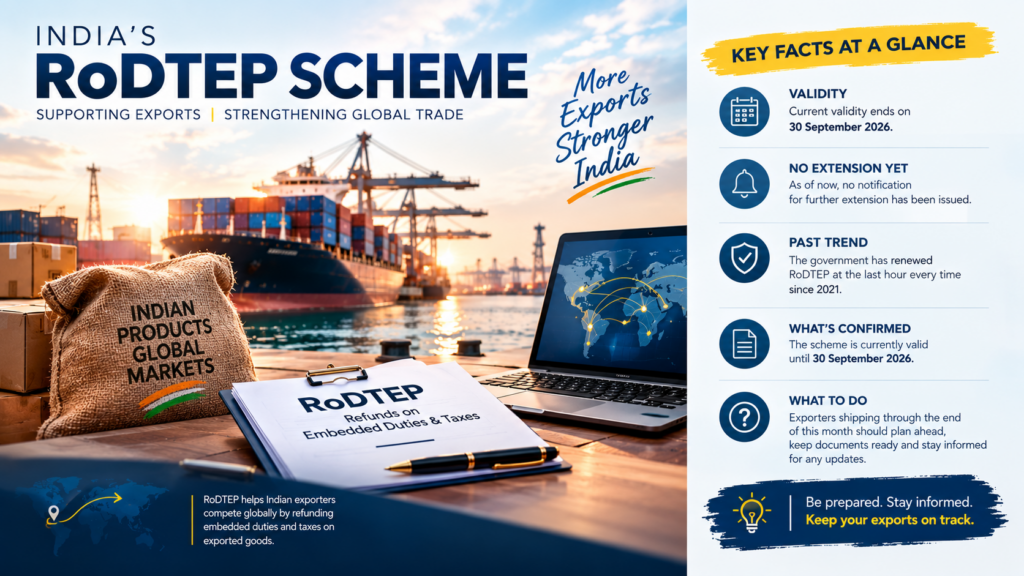
RoDTEP Scheme Deadline Is 7 Days Away — What Exporters Should Know

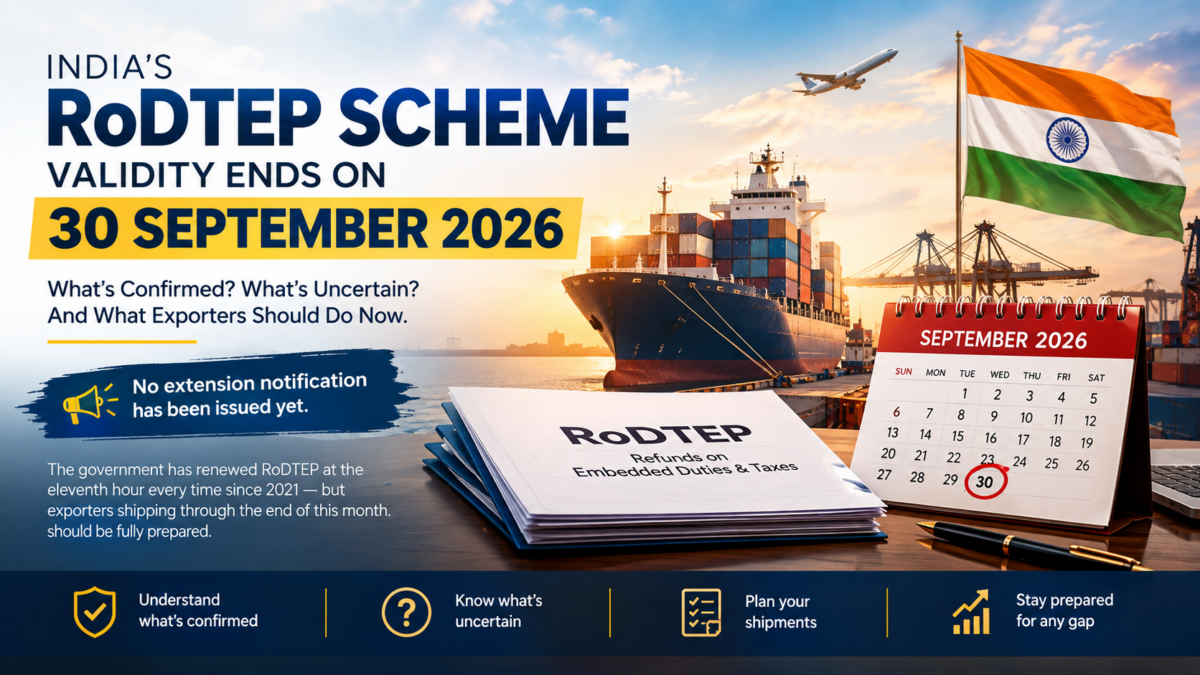
In 60 seconds: The current validity window of India’s RoDTEP scheme — the mechanism that refunds embedded duties and taxes on exported goods — ends on 30 September 2026, just seven days from today. As of now, no notification extending it further has been issued. This isn’t cause for panic: the government has renewed RoDTEP at the eleventh hour every single time it’s come up for expiry since 2021, but exporters shipping through the end of this month should understand exactly what’s confirmed, what isn’t, and what to do if the gap runs longer than expected.

⚡ Quick Facts

  • Current validity: 1 April 2026 to 30 September 2026, per DGFT Notification No. 74/2025-26 dated 31 March 2026
  • Deadline: 30 September 2026 — 7 days from today
  • Renewal status: No extension notification issued yet as of 23 September 2026
  • Historical pattern: Every prior RoDTEP extension (Sept 2025, March 2026) was notified on or right before the expiry date itself — none came early
  • Existing scrips: Already-generated RoDTEP scrips remain valid for one year from their generation date, regardless of what happens to the scheme after 30 September

What’s Happening?

RoDTEP — the Remission of Duties and Taxes on Exported Products — refunds embedded costs that don’t get reimbursed through GST or any other mechanism: things like mandi tax, fuel-linked duties, and electricity duty baked into production costs. Since its 2021 launch, it’s applied broadly across export categories, not just specific sectors, which is exactly why its expiry date matters to essentially every exporter, not a narrow group.

The scheme’s current window — 1 April to 30 September 2026 — was itself a six-month extension, notified on 31 March 2026, explicitly citing support for exporters navigating the West Asia crisis and its knock-on effects on freight and insurance costs. That notification kept rates and value caps under Appendix 4R (for DTA units) and Appendix 4RE (for Advance Authorisation, EOU and SEZ units) completely unchanged from what applied on 31 March.

Here’s the pattern worth knowing: this is not the first time RoDTEP has approached a cliff edge. It was extended from September 2025 to March 2026 via a notification dated 30 September 2025 — the very last day of the prior window. It was then extended again from March 2026 to September 2026 via a notification dated 31 March 2026 — again, the last possible day. In both cases, the government confirmed continuation right at the deadline, not ahead of it. If that pattern holds, a fresh notification for the period beyond 30 September 2026 could plausibly land in the coming days — but as of today, it hasn’t.

Why It Matters

For exporters with shipments planned around the end of September, this isn’t an abstract policy detail — it directly affects margin calculations on live contracts. RoDTEP benefits apply based on the Let Export Order (LEO) date or export realization falling within the valid window, so shipments cleared on or before 30 September are on solid ground under the current notification. What happens to shipments after that date, before any new notification lands, is the genuine open question.

The good news buried in the historical pattern: DGFT has never let this scheme lapse without eventually restoring it retroactively or continuing it seamlessly — exporters who’ve been through previous RoDTEP renewal cycles will recognize this as a recurring, if frustrating, feature of how the scheme gets administered rather than a sign it’s ending for good.

🇮🇳 Impact on Indian Exporters

  • If you have shipments with LEO dates on or before 30 September, your RoDTEP eligibility under the current notification is unaffected regardless of what happens next
  • For shipments planned just after 30 September, there’s a real — if likely temporary, based on precedent — window of uncertainty; factor this into margin planning for late-September and early-October contracts
  • Scrips you’ve already been issued stay valid for a full year from issuance, so existing scrip inventory isn’t at risk from this specific deadline
  • Keep a close watch on DGFT’s notification page over the next 7-10 days; based on the pattern, an extension notice is more likely to appear right at or just after 30 September than well ahead of it

🌍 Impact on Global Buyers

  • RoDTEP is a domestic Indian cost-support mechanism, not a duty or requirement that touches importers directly — but it factors into how competitively Indian suppliers can price against other origins
  • Buyers with ongoing Indian sourcing relationships don’t need to take any action here, but a genuinely extended lapse (which precedent suggests is unlikely) could eventually show up as firmer pricing from Indian exporters absorbing the gap
  • This is a useful data point for buyers tracking the broader stability of India’s export incentive framework, especially those weighing multi-year sourcing commitments

Opportunities and Risks

Opportunity: Exporters who understand this renewal pattern have an edge over those who panic-adjust pricing every time a scheme deadline approaches. Recognizing this as a recurring administrative rhythm — not a genuine policy reversal — allows for steadier planning than reacting to each cliff edge as a crisis.

Risk: Precedent isn’t a guarantee. Relying entirely on “it’s always been renewed before” without a contingency plan for shipments landing in the gap period is a real, if modest, risk — especially for exporters on thin margins where even a temporary benefit gap matters.

Practical Takeaway

If you have shipments scheduled right around 30 September, try to secure Let Export Order dates within the current window where operationally possible. For anything landing just after, keep half an eye on DGFT’s notification page over the next week or two rather than assuming continuity — and if you’re quoting new contracts for October shipments, it’s reasonable to build in a brief note about the pending renewal status rather than treating current RoDTEP rates as fully guaranteed until the next notification actually lands.

Trade Research Desk, Seabridge Exports Published:
23 September 2026 | Last Updated: 23 September 2026 This article is for informational purposes only and does not constitute legal, customs, or trade advisory. Please consult your CHA or trade consultant before acting on any export/import decision.

Categories
Uncategorized

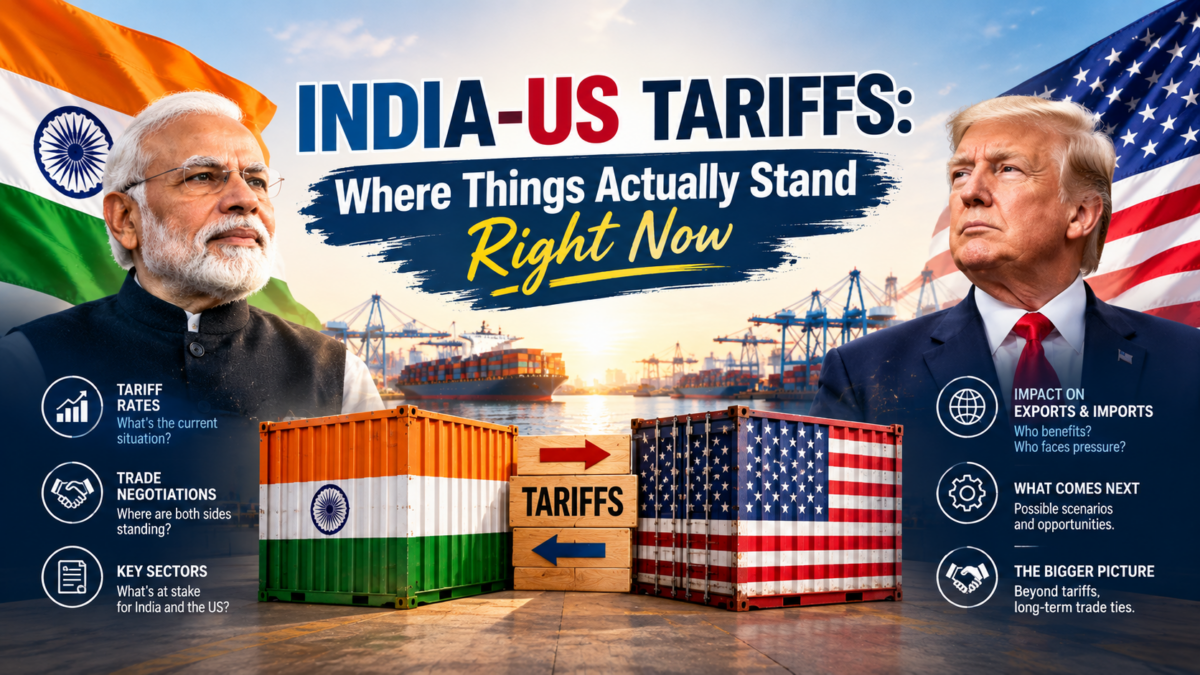
India-US Tariffs: Where Things Actually Stand Right Now

In 60 seconds: India’s exports to the US currently face an 18% tariff under the February 2026 Interim Trade Agreement — down sharply from a peak of 50% last year — but the comprehensive Bilateral Trade Agreement (BTA) that would lock this in remains unsigned. Commerce Minister Piyush Goyal has said India won’t announce final BTA details until Washington offers a genuinely preferential rate compared to competing exporters like Vietnam and Bangladesh, and a fresh Section 301 investigation into forced-labor practices adds a new layer of uncertainty on top. The next real checkpoint is the G20 Trade Ministerial in Milwaukee starting 30 September.

⚡ Quick Facts

  • Current effective tariff: 18% reciprocal tariff on most Indian goods, in place since 7 February 2026
  • Down from: A peak of 50% (25% reciprocal + 25% Russia-oil-linked penalty), which applied through most of late 2025
  • Latest ministerial statement: 3 September 2026 — Goyal says India will finalise BTA details only once the US offers preferential terms over India’s competitors
  • Pre-BTA review meeting: 1 September 2026 — Commerce Ministry met CII, FICCI, FIEO, Assocham and sector exporters
  • Next major checkpoint: G20 Trade Ministerial, Milwaukee, starting 30 September 2026 — expected Goyal-Greer bilateral

What’s the Current Status?

Here’s the timeline that gets you to today. In August 2025, the US imposed a 25% reciprocal tariff on Indian goods, then added a further 25% penalty tied to India’s continued purchases of Russian oil — pushing the combined tariff to 50%, among the highest the US applied to any major economy. That changed on 6-7 February 2026, when India and the US signed a joint statement establishing an Interim Trade Agreement: the US cut the reciprocal tariff to 18% and fully removed the Russia-linked penalty, in exchange for India eliminating or reducing tariffs on a wide range of US industrial and agricultural goods and committing to purchase over $500 billion in US products over five years.

That interim deal was always framed as phase one — a bridge to a fuller, comprehensive BTA covering market access, non-tariff barriers, digital trade and supply chain provisions. Since February, that fuller agreement has been in a holding pattern. Progress reports in June suggested the two sides were “99% finalized” before India pulled back over sticking points. By July, one detailed analysis described the BTA as genuinely stalled amid conflicting domestic priorities and fresh American tariff investigations.

Two developments this month bring the picture up to date. On 1 September, India’s Commerce Ministry — led by chief BTA negotiator Darpan Jain — met with major industry chambers and sector exporters to review trade performance ahead of the next negotiating push. Then on 3 September, Goyal stated plainly that India will only announce final BTA details once Washington agrees to give India preferential tariff terms relative to its competitors — meaning India isn’t simply seeking to lock in today’s 18% rate, but a rate meaningfully better than what Vietnam, Bangladesh or other competing exporters receive.

Layered on top of this is a newer complication: US trade authorities have reportedly proposed Section 301 tariffs tied to forced-labor concerns across roughly 54 countries, India included, as a potential parallel or replacement mechanism to existing tariff structures. This hasn’t been finalized, but it’s a live variable that didn’t exist even a few weeks ago.

Why It Matters

The core tension here is straightforward: India has functional, workable terms right now (18%, well below last year’s 50%), but is deliberately holding out for something better rather than accepting the interim rate as final. That’s a real negotiating stance, not just delay — Goyal’s comment about wanting preferential terms over competitors is specific and consequential. If India succeeds, exporters could see rates drop further, or gain a structural edge over Vietnam and Bangladesh in the US market. If talks drag on without resolution, the 18% rate remains merely provisional, not contractually locked in — and provisional rates can, in principle, move in either direction.

The forced-labor Section 301 angle adds a genuinely new risk dimension that’s separate from the reciprocal tariff conversation entirely. It’s a different legal mechanism, tied to labor practice concerns rather than trade balance or geopolitics, and it’s worth tracking independently rather than assuming it’s folded into the BTA talks.

Meanwhile, India’s actual export performance is already showing the benefit of the current reduced-tariff environment — August 2026 trade data released this month showed overall exports up over 25% year-on-year, with sectors like electronics and engineering goods posting particularly strong growth. That’s real evidence the 18% rate, even without a finalized BTA, is already working better for Indian exporters than the 50% environment did.

🇮🇳 Impact on Indian Exporters

  • The 18% rate is your current operating reality — but treat it as the floor of a negotiation, not a locked-in ceiling; Goyal’s own statements suggest India is pushing for something better, not just holding the line
  • Sectors named in the 1 September review — pharma, textiles, marine products, engineering, auto components — are the ones most likely to see direct movement whenever the final BTA text lands
  • If your business or your buyers involve labor-intensive manufacturing (textiles, leather, apparel), keep an independent eye on the Section 301 forced-labor tariff track — it moves on its own timeline and criteria, separate from the reciprocal tariff story
  • Contracts priced on the assumption that 18% is final and permanent carry real risk; build in a reassessment point around the 30 September G20 Trade Ministerial rather than locking in long-term US-bound pricing today

🌍 Impact on Global Buyers

  • US buyers sourcing from India are currently paying costs reflective of the 18% tariff environment — a meaningful improvement from the 50% period, but still not the final, settled number
  • If India successfully negotiates preferential terms over Vietnam and Bangladesh, Indian-origin goods could become comparatively more attractive to US buyers weighing multiple sourcing origins — worth watching if you’re actively comparing suppliers across these countries
  • Buyers in labor-intensive categories (textiles, apparel, leather) should track the Section 301 forced-labor investigation independently, since it could affect landed costs regardless of how the broader BTA resolves
  • The 30 September G20 Trade Ministerial is the concrete date to watch for any material movement — expect continued uncertainty until then

Opportunities and Risks

Opportunity: India’s public negotiating position — holding out for preferential terms rather than settling — signals confidence that current export momentum (reflected in August’s strong trade numbers) gives it leverage. If that strategy succeeds, exporters could see a genuinely better outcome than simply preserving the 18% status quo.

Risk: Two live, independent uncertainties are stacked on top of each other right now: whether the BTA concludes with better, worse, or unchanged terms, and whether the Section 301 forced-labor tariff track adds a new cost layer regardless of BTA outcomes. Businesses that treat this as a single, settled story risk being caught off guard by whichever track moves first.

Practical Takeaway

If you export to the US, don’t treat the current 18% tariff as a stable, long-term planning assumption — it’s the product of an interim agreement still awaiting its comprehensive successor, and India’s own commerce minister has said as much publicly. Mark 30 September on your calendar as the next real checkpoint, and if your product falls into a labor-intensive category, track the Section 301 forced-labor tariff proposal separately from the main BTA story, since it operates on its own track.

Trade Research Desk, Seabridge Exports Published:

18 September 2026 | Last Updated: 18September 2026. This article is for informational purposes only and does not constitute legal, customs, or trade advisory. Please consult your CHA or trade consultant before acting on any export/import decision.

Categories
Uncategorized

How to Import Agricultural Products from India | Complete Guide for Buyers (2026)

Planning to import agricultural products from India? Learn how to choose the right exporter, understand documentation, shipping terms, quality checks, and build reliable sourcing partnerships.

How to Import Agricultural Products from India: A Practical Guide for Global Buyers

Sourcing agricultural products from another country can feel overwhelming the first time. There are suppliers to evaluate, quality standards to understand, shipping terms to compare, and documentation that needs to be in order before a single container leaves the port.

Yet thousands of businesses around the world import from India every year with confidence.

The reason is simple. India has become one of the world’s most dependable suppliers of agricultural commodities, offering everything from premium Basmati Rice and Psyllium Husk to Groundnuts, Soybeans, Cotton, Spices, and Pulses. Combined with an experienced export community and a well-established logistics network, the country provides buyers with access to quality products at competitive prices.

Whether you’re a wholesaler expanding into a new market, a food manufacturer looking for reliable raw materials, or a distributor searching for a long-term supplier, understanding how the import process works will help you make better decisions from the very beginning.

This guide explains each step in a practical way, highlighting not only what to do but also why each stage matters.


Why Businesses Around the World Source Agricultural Products from India

India’s strength as an exporter isn’t based on one product or one region. The country grows an extraordinary range of crops thanks to its diverse climate, making it possible to supply agricultural products throughout much of the year.

Over the past decade, exporters have also invested heavily in processing technology, quality control, packaging, and international logistics. As a result, buyers are no longer choosing India only because of competitive pricing—they’re choosing it because they know experienced exporters understand international trade and can deliver consistently.

For businesses, that reliability often translates into fewer supply chain disruptions and stronger customer relationships.


Step 1: Start with a Clear Purchasing Plan

Before requesting quotations, take time to define exactly what your business needs.

This sounds obvious, but many sourcing problems begin with vague requirements.

Ask yourself a few important questions:

  • Which agricultural product are you looking for?
  • What quality standards must it meet?
  • How much quantity do you require?
  • Will the product be sold in bulk or retail packaging?
  • Does your market require private-label branding?
  • Are there any country-specific import regulations you must follow?

The clearer your requirements, the easier it becomes for exporters to prepare accurate quotations and recommend the right solution.


Step 2: Choose an Exporter, Not Just a Supplier

Price comparisons are part of every purchasing decision, but choosing an exporter based only on the lowest quotation can become expensive later.

An experienced exporter brings far more to the table than a competitive price.

They understand export documentation, shipping schedules, packaging standards, customs procedures, and the practical challenges involved in international trade. They also know how to communicate effectively when production schedules change or unexpected issues arise.

Before making a decision, ask about the company’s export experience, product range, production capacity, packaging options, and the markets they currently serve. A conversation often reveals more than a quotation ever will.


Step 3: Never Skip Product Samples

Even the most detailed product specification can’t replace seeing the product for yourself.

A sample allows you to check grain size, color, cleanliness, aroma, texture, moisture levels, and packaging quality before committing to a larger order.

For example, if you’re importing Basmati Rice for retail customers, you’ll want to see how the rice cooks, how much the grains elongate, and whether the aroma matches your market’s expectations. If you’re purchasing Psyllium Husk for food or pharmaceutical applications, you’ll likely need to verify purity and consistency.

Spending a little extra time on sampling can prevent expensive misunderstandings once production begins.


Step 4: Agree on Detailed Product Specifications

One of the most common causes of disputes in international trade is assuming both parties share the same understanding of “good quality.”

Instead of relying on general descriptions, agree on measurable specifications before production starts.

These may include:

  • Grade
  • Moisture level
  • Purity
  • Grain length or size
  • Packaging material
  • Bag weight
  • Label design
  • Pallet requirements
  • Container loading details

Documenting these requirements protects both buyer and supplier by ensuring everyone is working toward the same expectations.


Step 5: Understand Shipping Terms Before Confirming the Order

Shipping costs and responsibilities depend on the agreed Incoterms.

If you’re new to importing, it’s worth taking time to understand the differences.

With FOB (Free on Board), the exporter delivers the goods to the shipping port, and the buyer takes responsibility once the cargo is loaded onto the vessel.

Under CIF (Cost, Insurance and Freight), the exporter arranges ocean freight and insurance to the destination port, making the process simpler for many first-time importers.

Another commonly used option is CFR (Cost and Freight), where the exporter pays for transportation, while the buyer arranges insurance separately.

Clarifying these terms early helps avoid unexpected costs later.


Step 6: Review Export Documents Carefully

Documentation is one of the least visible but most important parts of international trade.

Even high-quality products can be delayed if paperwork is incomplete or inaccurate.

Depending on your destination country and product category, exporters typically prepare documents such as:

  • Commercial Invoice
  • Packing List
  • Bill of Lading
  • Certificate of Origin
  • Phytosanitary Certificate (when applicable)
  • Certificate of Analysis
  • Inspection Reports

Before shipment, verify that the documentation meets your country’s import requirements to avoid customs delays.


Step 7: Don’t Overlook Packaging

Packaging serves a much bigger purpose than protecting products during transport.

It affects storage efficiency, warehouse handling, retail presentation, regulatory compliance, and even transportation costs.

Many Indian exporters offer customized packaging solutions, including bulk industrial bags, retail-ready packaging, private-label branding, multilingual labels, and market-specific designs.

Discuss these details before production begins. Making packaging changes after manufacturing is often costly and time-consuming.

Step 8: Verify Quality Before Shipment

Once production is complete, quality verification becomes the final safeguard before export.

Professional exporters typically inspect the products for cleanliness, grading, weight, packaging quality, and container condition before loading.

Some international buyers also hire independent inspection agencies to confirm that the shipment matches the agreed specifications.

While inspections require additional planning, they can significantly reduce the likelihood of disputes after arrival.

Step 9: Stay Involved Until Delivery

The import process doesn’t end when the container leaves the port.

Maintain regular communication with your exporter or freight forwarder while the shipment is in transit. Tracking progress allows you to prepare customs documentation, organize warehouse space, and coordinate transportation before the cargo arrives.

Small updates during shipping often prevent much larger problems later.

Building a Long-Term Sourcing Partnership

The most successful importers rarely change suppliers every few months.

Instead, they invest in relationships with exporters who consistently deliver quality, communicate openly, and understand their business objectives.

Strong partnerships create advantages that go beyond pricing. They improve planning, simplify repeat orders, and make it easier to respond when market conditions change.

Over time, trust becomes one of the most valuable assets in international trade.


Frequently Asked Questions

Is India a reliable source for agricultural products?

Yes. India is one of the world’s leading agricultural exporters, supplying a wide range of products to international markets through experienced exporters and established logistics networks.

Should I request product samples?

Absolutely. Samples help verify quality, confirm specifications, and reduce the risk of misunderstandings before placing larger orders.

Which documents are commonly required for imports?

Most shipments include a Commercial Invoice, Packing List, Bill of Lading, Certificate of Origin, and any product-specific certificates required by the importing country.

Can exporters provide customized packaging?

Many Indian exporters offer private-label packaging, customized branding, retail packs, and bulk packaging solutions designed for different international markets.


Final Thoughts

Importing agricultural products from India isn’t simply about finding a supplier—it’s about choosing a business partner who understands your market, values consistency, and can support your growth over time.

The businesses that achieve the best results are usually those that invest time in planning, communicate clearly, verify product quality, and build relationships based on trust rather than short-term pricing.

With its broad agricultural base, experienced exporters, and expanding global trade network, India continues to be one of the most dependable sourcing destinations for companies seeking quality agricultural products.

If you approach the process with preparation and the right export partner, importing from India can become not just a successful transaction, but the beginning of a long-term business relationship that delivers value for years to come.

Categories
Uncategorized

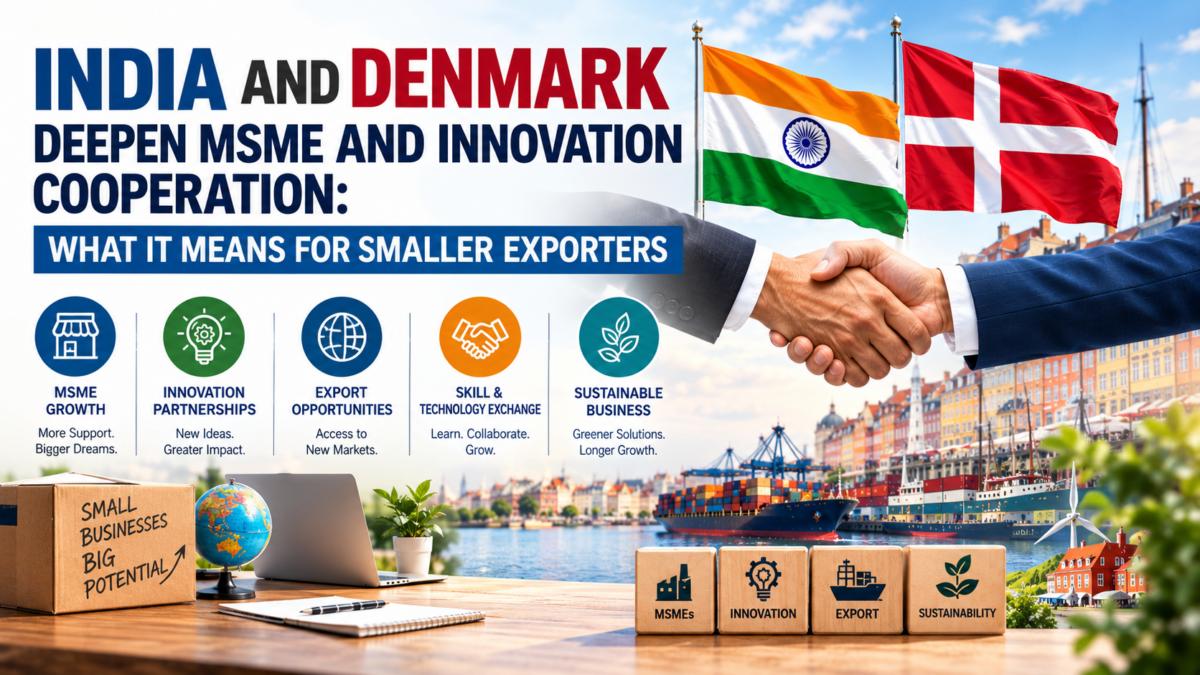
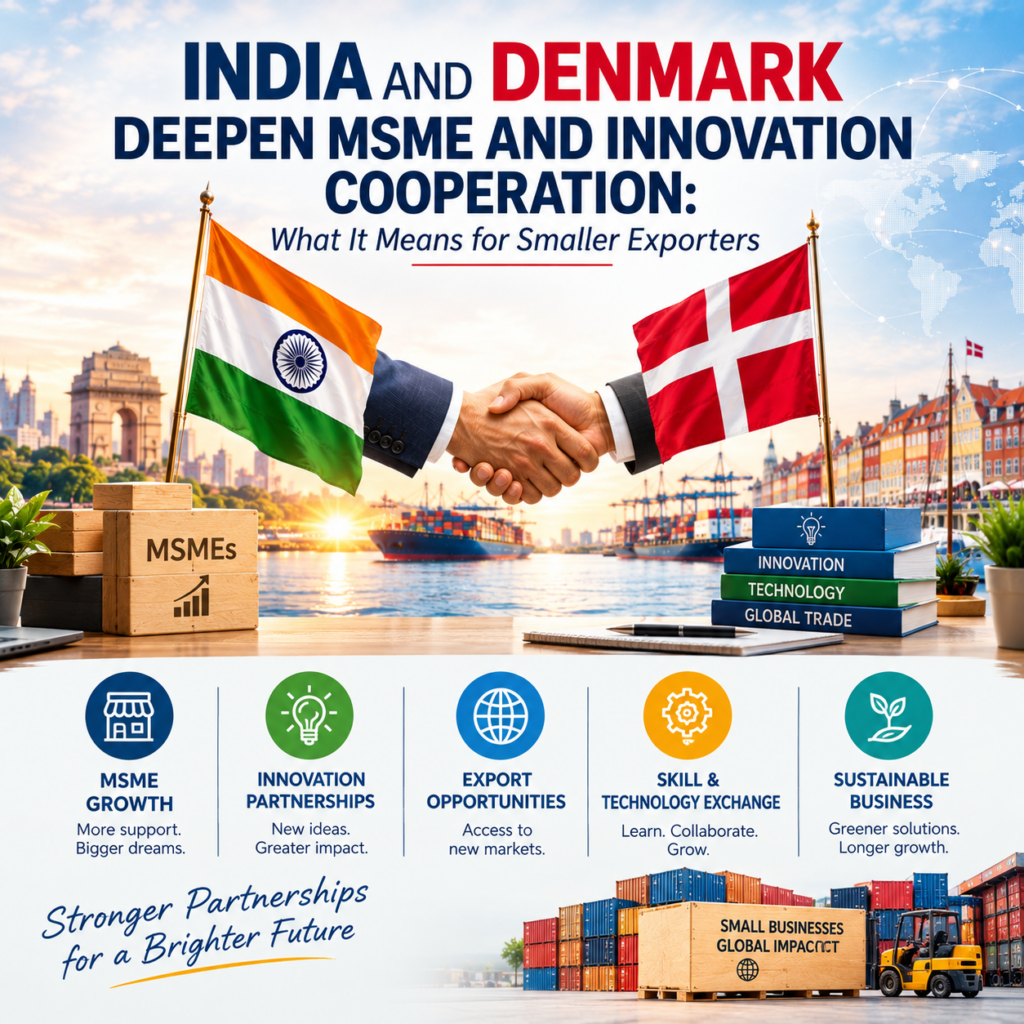
India and Denmark Deepen MSME and Innovation Cooperation: What It Means for Smaller Exporters

In 60 seconds: India and Denmark concluded the 4th meeting of their Joint Working Group on MSME development, agreeing to strengthen cooperation on innovation, technology adoption and intellectual property. It’s a lower-profile story than a tariff deal or trade agreement, but it sits on top of a genuinely growing India-Denmark trade relationship — one where agricultural commodities, textiles and engineering goods already feature on India’s export list.

⚡ Quick Facts

  • Meeting: 4th India-Denmark Joint Working Group (JWG), held in Copenhagen, 24–28 August 2026
  • Participants: India’s Ministry of MSME and the Danish Patent and Trademark Office (DKPTO)
  • Focus areas: Innovation, technology adoption, technology commercialisation, intellectual property, entrepreneurship, cluster development
  • Bilateral trade: ~$2.05 billion in goods (2025); ~$4.25 billion in services
  • Danish investment: Around 200 Danish companies currently invested in India

What Happened?

India’s Ministry of Micro, Small and Medium Enterprises and Denmark’s Patent and Trademark Office wrapped up the 4th meeting of their bilateral Joint Working Group in Copenhagen, running from 24 to 28 August 2026. The discussions centered on how the two countries can deepen cooperation specifically for smaller businesses — covering technology adoption, innovation support, IP protection, technology commercialisation, entrepreneurship, and cluster development.

India’s Ambassador to Denmark, Manish Prabhat, welcomed the continued functioning of the JWG mechanism and encouraged both sides to explore additional areas of cooperation going forward. This is explicitly framed as an ongoing working relationship rather than a one-time announcement — the “4th meeting” framing signals a structured, recurring dialogue rather than a single headline event.

Why It Matters

On its own, an MSME working group meeting doesn’t move markets. What makes it worth a closer look is the trade relationship it sits inside. India’s exports to Denmark already span textiles, apparel and yarns, vehicles and components, metal goods, iron and steel, leather, travel goods, agricultural commodities, seafood, pharmaceuticals and engineering products — a genuinely diverse basket, not a single-commodity relationship. Indian exports to Denmark reportedly exceeded their 2025-26 target, reaching 106% of the goal set by the Commerce Ministry.

The MSME and IP focus matters because it targets exactly the segment of Indian exporters — smaller, product-focused, often without in-house R&D or legal teams — that tends to be underserved by big-ticket trade agreements. Better access to technology, innovation support and IP protection mechanisms can help these businesses improve product quality, meet European compliance standards more easily, and compete on more even footing with larger players. That’s a slower, less headline-grabbing kind of trade support, but it’s often more directly useful to a mid-sized exporter than a tariff announcement they may not even be positioned to benefit from yet.

🇮🇳 Impact on Indian Exporters

  • If you’re a smaller exporter (agri commodities, textiles, engineering goods, or other categories already active in the Danish market), this cooperation framework is aimed at making European market entry easier over time — worth watching for concrete programs or support schemes that emerge from it
  • IP protection support is particularly relevant for exporters with branded products or proprietary processing methods, since navigating a foreign IP system alone is a common barrier for smaller businesses
  • The fact that Indian exports to Denmark already exceeded target this year suggests genuine, ongoing demand in this market — a reasonable proof point for exporters evaluating whether Denmark and the wider Nordic region are worth pursuing
  • Nothing concrete (funding, specific schemes, timelines) was announced in this round — treat this as a policy direction to track, not an immediate program to apply for

🌍 Impact on Danish Buyers and Businesses

  • Danish companies sourcing from India may see gradually improving product quality and IP clarity from Indian MSME suppliers as this cooperation matures
  • The roughly 200 Danish companies already invested in India stand to benefit from a more innovation-friendly MSME ecosystem locally, since many rely on Indian manufacturing and component partners
  • Danish buyers exploring new Indian suppliers, particularly smaller or first-time exporters, may find IP and quality documentation somewhat easier to verify as these frameworks develop

Opportunities and Risks

Opportunity: For MSME exporters specifically, government-to-government cooperation frameworks like this one are worth watching closely — they often precede specific support schemes, funding windows, or trade facilitation programs a few months down the line. Getting on the radar of relevant industry bodies (export promotion councils, MSME ministry outreach) now positions smaller exporters to benefit early.

Risk: Working-group outcomes like this are inherently slow-moving and non-binding — there’s a real risk of treating this as more consequential than it currently is. No specific scheme, funding amount, or timeline has been announced yet; exporters should wait for concrete program details before making business decisions based on this cooperation alone.

Practical Takeaway

If you’re a smaller or mid-sized Indian exporter — particularly in textiles, agri commodities, or engineering goods — with an eye on the European market, Denmark’s steady, above-target trade performance with India is a reasonable data point in its favour. Keep this MSME-IP cooperation track on your radar for future concrete programs, but don’t wait on it; if Denmark or the wider Nordic market fits your product, direct buyer outreach today doesn’t need to wait for this cooperation framework to mature.

Trade Research Desk, Seabridge Exports Published: 9 September 2026 | Last Updated: 9 September 2026 This article is for informational purposes only and does not constitute legal, customs, or trade advisory. Please consult your CHA or trade consultant before acting on any export/import decision.

Categories
Uncategorized

India-Argentina Trade Talks Open Doors for Farm and Pharma Exports

In 60 seconds: At the 4th India-Argentina Joint Trade Committee meeting in Buenos Aires, both countries advanced market access talks for Indian onions, milk products, grapes, potatoes, bananas and pulses, alongside progress on upgrading India’s pharmaceutical export status. The talks come as bilateral trade crossed $6.5 billion in 2025, growing over 17% annually — with India now Argentina’s fifth-largest trading partner and clear momentum toward opening a market that’s largely been a one-way street of edible oil imports into India.

⚡ Quick Facts

  • Meeting: 4th India-Argentina Joint Trade Committee (JTC), Buenos Aires, 24 August 2026
  • Delegations: Commerce Secretary Rajesh Agrawal (India), Ambassador Fernando Brun (Argentina)
  • Farm products in progress: Onions, milk and milk products, grapes, potatoes, bananas, pulses — technical SPS talks underway
  • Pharma progress: Argentina to work on upgrading India from Annex II to Annex I under its pharmaceutical regulatory framework
  • Bilateral trade: Crossed $6.5 billion in 2025, up 17%+ year-on-year; India is now Argentina’s 5th-largest trading partner

What Happened?

India and Argentina held their 4th Joint Trade Committee meeting in Buenos Aires on 24 August 2026, led by Commerce Secretary Rajesh Agrawal on the Indian side and Ambassador Fernando Brun, Argentina’s Secretary for International Economic Relations. The talks covered agriculture, minerals, energy, pharmaceuticals, healthcare, tourism, banking and telecommunications, with an explicit focus on turning government-level discussions into actual business partnerships.

Two developments stand out for exporters. First, Argentina committed to working toward upgrading India’s status from Annex II to Annex I under its pharmaceutical regulatory framework — a shift that would meaningfully ease approval barriers for Indian drugmakers entering the Argentine market. Second, both sides reported progress on sanitary and phytosanitary (SPS) measures for a specific list of Indian farm products — onions, milk and milk products, grapes, potatoes, bananas and pulses — with technical-level discussions now underway to get these into the Argentine market.

The meeting also touched on the India-MERCOSUR Preferential Trade Agreement, active since 2009, with progress reported on updating its terms and moving toward digital certificates of origin to simplify cross-border trade. Separately, the two sides discussed mining and energy cooperation, including India’s KABIL completing Phase II drilling at its lithium project in Catamarca province.

Why It Matters

The trade relationship between India and Argentina has, for years, run heavily in one direction: Argentina ships India roughly $3.9 billion worth of goods annually, and the overwhelming majority of that — well over 80% — is edible oils and fats (soybean oil in particular). India’s exports back to Argentina have been comparatively modest and narrow. This JTC round is notable precisely because it’s aimed at correcting that imbalance — pushing specific Indian farm products toward real market access rather than leaving the relationship defined by a single commodity flow.

The SPS clearance process for products like onions, milk, grapes and pulses is genuinely significant groundwork, even though it hasn’t concluded yet. Sanitary and phytosanitary approval is usually the single biggest bottleneck standing between “trade agreement in principle” and “goods actually clearing customs” for agricultural products — it’s where technical, science-based negotiations happen product by product, and it can take months to years. The fact that six specific product categories are now at this stage is a concrete, trackable signal, not just diplomatic goodwill language.

🇮🇳 Impact on Indian Exporters

  • Exporters of onions, dairy, grapes, potatoes, bananas and pulses now have a specific, named pathway opening into a market of over 45 million people — worth tracking closely as SPS technical talks progress
  • The India-MERCOSUR PTA update, if it lands, would extend potential access beyond Argentina alone to the wider bloc (Brazil, Uruguay, Paraguay) — a meaningfully larger opportunity for the same product categories
  • Pharma exporters should watch the Annex I upgrade process closely, as it directly reduces regulatory friction for entering Argentina — a market where Indian generics currently have limited penetration
  • None of this is finalized yet — “technical-level discussions are underway” means months of SPS negotiation likely remain before actual shipments can begin; exporters should treat this as an early-stage signal to prepare documentation and compliance readiness, not an immediate green light

🌍 Impact on Buyers in Argentina

  • Argentine importers and distributors in dairy, produce and pulses may soon have a new, price-competitive sourcing option from India once SPS clearances finalize
  • Healthcare providers and pharmacies stand to benefit from the Annex I upgrade, which would bring more affordable Indian generic medicines into reach faster
  • The push toward digital certificates of origin under the India-MERCOSUR PTA update should reduce paperwork friction for Argentine businesses importing from India across the board, not just in the newly discussed categories

Opportunities and Risks

Opportunity: Exporters in the six named product categories have a rare, concrete heads-up here — government-to-government SPS talks don’t happen for products without real intent to open the market. Getting export documentation, quality certifications and Argentine buyer relationships in order now, ahead of formal clearance, is a legitimate first-mover strategy.

Risk: SPS negotiations are technical and can stall or take far longer than initial optimism suggests — treat “progress” and “technical discussions underway” as meaningfully short of “market open.” Exporters shouldn’t commit resources assuming a firm timeline; watch for the actual regulatory notification before treating this as market-ready.

Practical Takeaway

If you export onions, dairy, grapes, potatoes, bananas or pulses, this is worth adding to your radar — start researching Argentina’s specific import requirements and identifying potential distributor relationships now, so you’re ready to move quickly once SPS clearance comes through. For pharma exporters, keep an eye on Argentina’s Annex I upgrade process as a concrete milestone that will directly ease your regulatory path.

Trade Research Desk, Seabridge Exports Published:
7 September 2026 | Last Updated: 7 September 2026
This article is for informational purposes only and does not constitute legal, customs, or trade advisory. Please consult your CHA or trade consultant before acting on any export/import decision.

Categories
Uncategorized

India and US Deepen Critical Minerals Ties: The Bigger Trade Story Behind the Headline

In 60 seconds: Finance Minister Nirmala Sitharaman and US Treasury Secretary Scott Bessent met on the sidelines of the G20 Finance Ministers meeting and committed to deepening India-US cooperation on critical minerals, with a follow-up visit to New Delhi planned later this year. The meeting itself was a short diplomatic readout without new deal terms — but it sits on top of a much bigger, genuinely consequential story: India’s fast-moving push to become a serious player in a supply chain China has dominated for decades.

⚡ Quick Facts

  • Meeting: Sitharaman and Bessent, on the sidelines of the G20 FMCBG Meeting, Asheville, North Carolina, 31 August 2026
  • Outcome: Commitment to deepen cooperation on critical minerals; Bessent invited to New Delhi later this year for an “Economic & Financial Partnership” dialogue
  • Context cited: India’s participation in G7-led critical mineral dialogues on supply chain security
  • Global backdrop: China controls roughly 90% of global rare earth processing and magnet manufacturing capacity
  • India’s response: ₹16,300 crore National Critical Mineral Mission, ₹7,280 crore rare earth magnet manufacturing scheme, and dedicated mineral corridors across four states

What Happened?

Sitharaman and Bessent met on the sidelines of the G20 Finance Ministers and Central Bank Governors meeting in Asheville, North Carolina, where the two acknowledged the long-standing India-US relationship and agreed to deepen cooperation across several areas, critical minerals among them. Bessent specifically welcomed India’s participation in G7-led critical mineral dialogues focused on securing supply chains and sharing research and technology, and Sitharaman invited him to New Delhi later this year for a dedicated Economic & Financial Partnership dialogue.

It’s worth being direct about scope here: this was a short diplomatic statement, not an agreement with specific commitments, timelines or numbers attached. The real substance to watch is what comes out of that planned New Delhi visit.

Why It Matters

The reason this modest meeting is generating so much coverage is the backdrop it sits against. China currently controls close to 90% of global rare earth processing and permanent magnet manufacturing, and roughly 60% of mining — a concentration that became a live global risk when China tightened export controls on key rare earth elements starting in 2025. Industries dependent on these materials — electric vehicles, wind turbines, defence electronics, consumer electronics — got a direct reminder of how exposed they were to a single-country chokepoint.

India has responded with unusual speed for a multi-year industrial strategy. Since late 2025, the government has approved a ₹7,280 crore Rare Earth Permanent Magnet manufacturing scheme, announced dedicated Rare Earth Corridors across Odisha, Kerala, Andhra Pradesh and Tamil Nadu, cut import duty on monazite (a key rare earth source ore) to zero, and backed the broader National Critical Mineral Mission with over ₹16,300 crore in direct spending. On the international side, India’s state-run KABIL has signed overseas mineral deals — including lithium exploration blocks in Argentina — and India is a member of the Minerals Security Partnership, a grouping of major economies coordinating on supply chain diversification.

Today’s Sitharaman-Bessent meeting is best read as one data point in that larger alignment: the US, like other G7 economies, is actively courting India as a partner in de-risking critical mineral supply chains away from China. That’s a genuinely significant multi-year trend — even though this particular meeting didn’t produce new deal terms.

🇮🇳 Impact on Indian Exporters

  • Most Indian exporters won’t feel direct impact from this specific meeting — India’s rare earth processing capacity is still in early build-out, not yet at export scale
  • Exporters and manufacturers in EV components, defence electronics, renewable energy equipment and allied sectors should treat this as a signal worth tracking closely, since policy and diplomatic momentum in this space is moving faster than the underlying infrastructure
  • Businesses located near or connected to the announced mineral corridors (Odisha, Kerala, Andhra Pradesh, Tamil Nadu) may see logistics, processing and ancillary supply opportunities emerge over the next few years as these corridors develop
  • The planned New Delhi “Economic & Financial Partnership” visit later this year is the concrete milestone to watch for any specifics that move beyond diplomatic language

🌍 Impact on Global Buyers

  • Buyers currently dependent on China for rare earths and critical minerals should note India as an emerging — not yet mature — alternative; capacity constraints mean this is a multi-year diversification play, not an immediate sourcing switch
  • The broader G7-aligned push toward supply chain diversification (also involving Australia, Japan, the EU, and now more visibly the US-India track) suggests buyers should expect more announcements in this space through 2026-27, even if today’s specific meeting was light on detail
  • International buyers evaluating India for future mineral or magnet sourcing should watch India’s REPM scheme rollout and corridor development timelines rather than diplomatic statements for real signals of capacity coming online

Opportunities and Risks

Opportunity: For businesses positioned in or adjacent to India’s critical minerals build-out — manufacturing, logistics, skilled labour, ancillary chemicals — sustained diplomatic and policy momentum like this meeting tends to precede real investment. Early positioning near the announced corridors could pay off over a multi-year horizon.

Risk: There’s a real gap between diplomatic momentum and delivered capacity in this space right now — India’s processing infrastructure is still nascent, and readouts like today’s meeting can create an impression of progress that outpaces what’s actually deployable. Businesses should avoid treating this specific news as an immediate trade signal and instead watch for concrete scheme rollouts, corridor completions, and the outcomes of the planned New Delhi dialogue.

Practical Takeaway

For most exporters, today’s meeting doesn’t require any immediate action — it’s a diplomatic signal, not a policy change. If your business touches EV components, defence electronics, renewable energy manufacturing, or sits near the announced mineral corridor states, it’s worth bookmarking this story and watching for the New Delhi “Economic & Financial Partnership” visit later this year, which is where actual specifics are more likely to emerge.

Trade Research Desk, Seabridge Exports Published:
1 September 2026 | Last Updated: 1 September 2026
This article is for informational purposes only and does not constitute legal, customs, or trade advisory. Please consult your CHA or trade consultant before acting on any export/import decision.

Categories
Uncategorized

DGFT Automates Free Sale Certificate Issuance: Faster Approvals for Exporters

The Directorate General of Foreign Trade (DGFT) has moved to automated issuance of Free Sale and Commerce Certificates (FSC) for eligible applications, removing the mandatory manual scrutiny step that used to slow the process down. The change, notified on 31 August 2026 and announced today, is aimed squarely at cutting processing time and compliance burden for exporters of products outside the Drugs & Cosmetics Act — a category that includes a large share of food, agri and general merchandise exports.

⚡ Quick Facts

  • What changed: DGFT now auto-issues eligible Free Sale and Commerce Certificate (FSC) applications, skipping mandatory manual review
  • Notification: DGFT Trade Notice No. 24/2026-2027, dated 31 August 2026
  • Announced: 1 September 2026, by the Ministry of Commerce and Industry
  • Who it covers: Products not covered under the Drugs & Cosmetics Act, 1940 (most food, agri, and general export categories)
  • What doesn’t change: Applications needing verification, or that don’t meet automated-processing conditions, still go to manual review at the Regional Authority

What Happened?

DGFT has introduced a system-driven, automated workflow for issuing Free Sale and Commerce Certificates, according to Trade Notice No. 24/2026-2027 dated 31 August 2026. Until now, exporters could apply online, but every application was routed to the concerned DGFT Regional Authority for manual analysis, verification and sign-off — a step the notice itself describes as adding substantial processing time.

Under the new system, applications that meet the defined automated-processing parameters will be issued directly without that manual scrutiny step. The Ministry has framed this as a shift from a manual, RA-dependent process to a paperless, system-driven one, with the explicit goal of shorter and more predictable turnaround times.

Importantly, this isn’t a blanket removal of oversight. Applications that require additional verification, or fall outside the parameters set for automated processing, will continue to be routed to the Regional Authority as before. DGFT has also retained a risk-management layer — some applications approved automatically can still be flagged for review after the fact if they’re picked up under this system.

Why It Matters

Free Sale Certificates are one of those unglamorous but genuinely load-bearing pieces of export documentation. Many importing countries require proof that a product is freely sold and legally marketed in its country of origin before allowing it into their market — and for exporters of food ingredients, nutraceuticals, cosmetics-adjacent products and general merchandise (anything outside the Drugs & Cosmetics Act), the FSC is often exactly that proof.

Every extra week spent waiting on a manually-processed certificate is a week a shipment or a buyer contract can stall. For exporters running on tight buyer timelines — especially smaller and mid-sized exporters without dedicated compliance teams — a faster, more predictable FSC turnaround removes a genuine friction point, not just a paperwork inconvenience.

This also fits a broader pattern DGFT has been pushing this year: reducing manual intervention across trade documentation to make compliance faster without removing it entirely. The retained risk-management flagging shows the intent is speed with continued oversight, not deregulation.

🇮🇳 Impact on Indian Exporters

  • If your product falls outside the Drugs & Cosmetics Act — most food ingredients, agri commodities, and general merchandise — your next FSC application may clear without the manual review delay that exporters have dealt with for years
  • Faster FSC turnaround directly helps meet buyer-side documentation deadlines, particularly useful when a new export market requires this certificate before customs clearance
  • Applications with any ambiguity (product classification, prior compliance flags, incomplete documentation) will still route to manual review — clean, complete applications are more likely to benefit from the faster path
  • Worth checking with your CHA or compliance team whether your specific product category and application history meet the “automated processing parameters” DGFT has defined, since these details weren’t fully public at time of writing

🌍 Impact on Global Buyers

  • Faster FSC issuance on the Indian side means fewer supplier-side documentation delays holding up shipments — a small but real reliability improvement for buyers sourcing from India
  • Buyers requiring FSC as part of import compliance (common for food, nutraceutical and general merchandise categories) may see more predictable lead times from Indian suppliers going forward
  • This is a process change, not a change to certification standards — the underlying requirements for what qualifies as “freely sold” in India remain the same, so due diligence on supplier legitimacy is still necessary

Opportunities and Risks

Opportunity: Exporters who’ve historically found FSC processing to be a bottleneck now have a concrete reason to revisit their documentation practices — clean, well-prepared applications are the ones most likely to benefit from the automated path rather than getting bounced to manual review anyway.

Risk: The exact automated-processing parameters DGFT is using haven’t been fully detailed publicly yet. Exporters shouldn’t assume automatic approval as a given — treat this as a potential speed-up to plan around, not a guarantee, until you’ve tested it with an actual application or confirmed specifics with your CHA.

Practical Takeaway

If FSC is part of your regular export documentation, it’s worth submitting your next application with extra attention to completeness and accuracy — that’s the profile most likely to clear through the new automated path. If you’re unsure whether your product category and compliance history qualify, a quick check with your customs house agent before applying can save a redundant back-and-forth.

Trade Research Desk, Seabridge Exports Published:
1 September 2026 | Last Updated: 1 September 2026
This article is for informational purposes only and does not constitute legal, customs, or trade advisory. Please consult your CHA or trade consultant before acting on any export/import decision.

Categories
Uncategorized

India-US Trade Talks Resume Today: What Exporters Should Know Before the Bilateral Trade Agreement

India’s Commerce Ministry met exporters, export promotion councils and industry chambers today to review India-US trade performance and discuss the ongoing Bilateral Trade Agreement (BTA) negotiations. The meeting, chaired by India’s chief BTA negotiator, comes weeks before Commerce Minister Piyush Goyal travels to the US for the G20 Trade Ministerial and direct talks with the US Trade Representative — making this a genuine checkpoint moment for exporters watching where tariffs and market access go next.

⚡ Quick Facts

  • Meeting date: 1 September 2026, chaired by Additional Secretary Darpan Jain
  • Jain’s role: India’s chief negotiator for the India-US Bilateral Trade Agreement (BTA)
  • Participants: CII, FICCI, Assocham, FIEO, and sector representatives from pharma, engineering, textiles, agriculture, chemicals, marine products, leather, automobiles, auto components, handicrafts and plastics
  • Next milestone: Goyal’s US visit in late September for the G20 Trade Ministerial in Milwaukee (starting 30 September), plus bilateral talks with USTR Jamieson Greer
  • Current tariff backdrop: US reciprocal tariff on Indian goods stands at roughly 18%, down from a peak of 50%, following the February 2026 Interim Trade Agreement

What Happened?

India’s Commerce Ministry convened exporters, export promotion councils and industry chambers today to take stock of India-US trade performance and sector-wise developments as negotiations toward a comprehensive Bilateral Trade Agreement continue. The meeting was chaired by Additional Secretary Darpan Jain, who also serves as India’s chief negotiator for the BTA.


Representatives across a wide sweep of export-heavy sectors joined — pharmaceuticals, engineering goods, textiles, agriculture, chemicals, marine products, leather, automobiles, auto components, handicrafts and plastics — alongside the country’s major industry bodies: CII, FICCI, Assocham and FIEO. The discussion centered on recent trade trends, how individual sectors are performing under the current tariff regime, and the practical issues exporters want addressed as the BTA moves toward finalization.

The timing isn’t incidental. Goyal is scheduled to travel to the US in late September to attend the two-day G20 Trade Ministerial in Milwaukee, which begins 30 September, and to hold direct bilateral talks with US Trade Representative Jamieson Greer. Today’s meeting functions as India’s internal alignment step before that higher-level round.

Why It Matters

This sits on top of a genuinely volatile 18 months of India-US tariff history. The US imposed a 26% reciprocal tariff on Indian goods in April 2025, which escalated further with an additional 25% penalty tied to India’s Russian oil purchases — pushing the combined effective tariff to 50% by late August 2025, among the highest the US applied to any major trading partner.

That changed with the February 2026 Interim Trade Agreement, which cut the reciprocal tariff to 18% and removed the Russia-linked penalty tariff entirely, in exchange for India committing to reduce duties on a range of US industrial and agricultural goods and to purchase over $500 billion in US energy, technology and other products over five years. Notably, India kept dairy, a broad range of spices, select grains like rice and wheat, and certain frozen or preserved vegetables outside the scope of that tariff reduction — a detail worth remembering for agri exporters specifically.

The Interim Agreement was always framed as a bridge to a fuller BTA, not the final word. Today’s meeting, and the run-up to the G20 Trade Ministerial, is where that fuller agreement gets shaped — covering non-tariff barriers, market access details, and sector-specific terms that the interim deal left open. For exporters, the direction these talks take over the next month has more practical weight than most single news cycles this year.

🇮🇳 Impact on Indian Exporters

  • The 18% tariff (versus the earlier 50%) is currently the operating baseline — but it isn’t guaranteed to be final until the BTA is signed, so contracts and pricing built on today’s rate carry some forward-looking risk
  • Sectors named in today’s meeting — pharma, textiles, marine products, engineering, auto components — are the ones most likely to see sector-specific movement in the coming BTA text; exporters in these categories should watch for direct outreach from FIEO or their sector’s export promotion council
  • Agri exporters should note that dairy, spices, and select grains were excluded from India’s tariff-reduction commitments under the interim deal — this carve-out may or may not extend into the final BTA, so it’s worth tracking specifically rather than assuming stability
  • The $500 billion purchase commitment India has made to the US (energy, tech, aircraft parts, coking coal) is a large enough number that it may shape broader trade sentiment and rupee-dollar dynamics over the coming years — relevant context for anyone pricing long-term USD contracts

🌍 Impact on Global Buyers

  • Buyers sourcing from India for the US market should treat current landed costs as provisional; a finalized BTA later this year could shift effective tariffs again, in either direction depending on sector
  • US buyers specifically should note India’s carve-outs (dairy, spices, select grains) remain higher-duty categories for now, which affects cost comparisons against other origins for those product lines
  • The broader signal — India and the US actively negotiating rather than escalating — reduces near-term disruption risk for buyers who had diversified away from India during the 2025 tariff spike, and may make India a more attractive re-entry option
  • Buyers should watch the 30 September G20 Trade Ministerial and the Goyal-Greer bilateral as the next concrete checkpoint, rather than expecting resolution before then

Opportunities and Risks

Opportunity: Exporters in the sectors directly represented at today’s meeting have a live channel to flag specific pain points before the BTA text is finalized — through FIEO, CII, FICCI or Assocham. That’s a meaningfully open window compared to reacting after an agreement is signed.

Risk: The most likely failure mode here isn’t a bad deal — it’s exporters assuming the current 18% rate and existing carve-outs are permanent when they’re explicitly still under negotiation. Anyone pricing multi-month or multi-year US contracts right now should build in a tariff-revision clause or reassessment point rather than locking in today’s numbers indefinitely.

Practical Takeaway

If your export business touches the US market — directly or through buyers who resell there — treat the next four weeks as an active watch period, not background noise. The concrete date to track is 30 September, when the G20 Trade Ministerial and the Goyal-Greer bilateral take place. Until then, avoid long-term US-bound contracts priced on the assumption that today’s 18% tariff and current product carve-outs are locked in.

Sources
  • SiliconIndia — India-US Trade Talks Gain Focus Ahead of September 1 Meeting
  • Business Standard — Commerce Ministry Meeting Industry, Exporters on India-US Trade on Sept 1
  • India Briefing — US-India Strike Interim Trade Deal, Cut Tariffs to 18%
  • UNESCAP — India-US Bilateral Trade Agreement and Implications for South Asia