
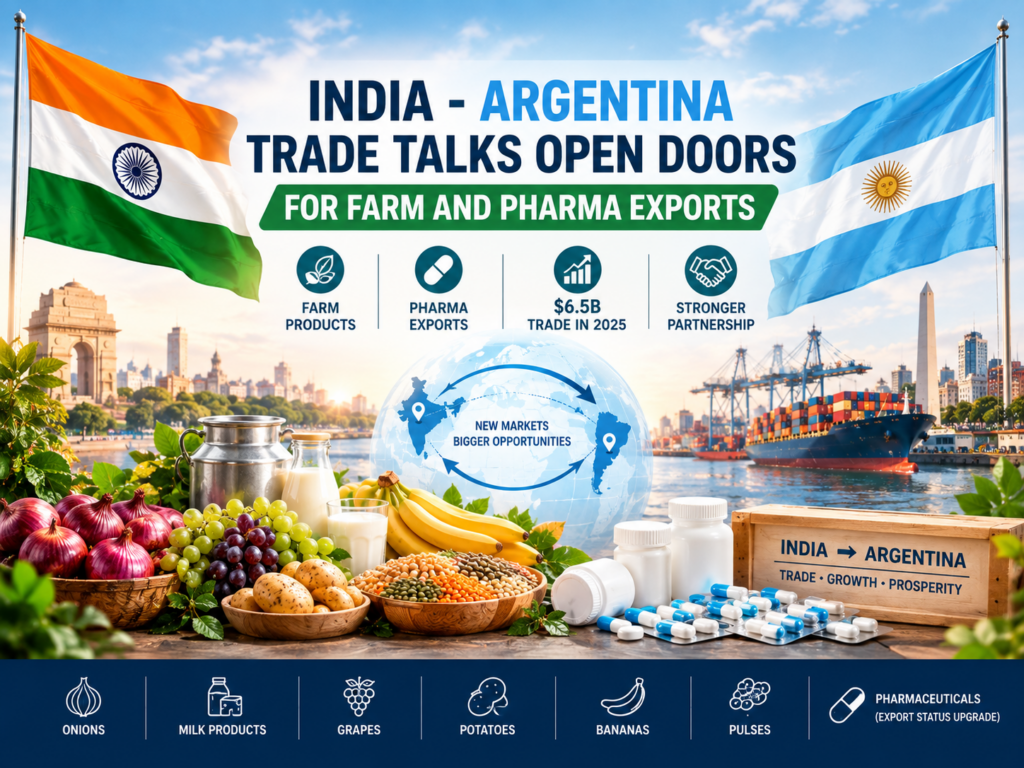
In 60 seconds: At the 4th India-Argentina Joint Trade Committee meeting in Buenos Aires, both countries advanced market access talks for Indian onions, milk products, grapes, potatoes, bananas and pulses, alongside progress on upgrading India’s pharmaceutical export status. The talks come as bilateral trade crossed $6.5 billion in 2025, growing over 17% annually — with India now Argentina’s fifth-largest trading partner and clear momentum toward opening a market that’s largely been a one-way street of edible oil imports into India.
⚡ Quick Facts
- Meeting: 4th India-Argentina Joint Trade Committee (JTC), Buenos Aires, 24 August 2026
- Delegations: Commerce Secretary Rajesh Agrawal (India), Ambassador Fernando Brun (Argentina)
- Farm products in progress: Onions, milk and milk products, grapes, potatoes, bananas, pulses — technical SPS talks underway
- Pharma progress: Argentina to work on upgrading India from Annex II to Annex I under its pharmaceutical regulatory framework
- Bilateral trade: Crossed $6.5 billion in 2025, up 17%+ year-on-year; India is now Argentina’s 5th-largest trading partner
What Happened?
India and Argentina held their 4th Joint Trade Committee meeting in Buenos Aires on 24 August 2026, led by Commerce Secretary Rajesh Agrawal on the Indian side and Ambassador Fernando Brun, Argentina’s Secretary for International Economic Relations. The talks covered agriculture, minerals, energy, pharmaceuticals, healthcare, tourism, banking and telecommunications, with an explicit focus on turning government-level discussions into actual business partnerships.
Two developments stand out for exporters. First, Argentina committed to working toward upgrading India’s status from Annex II to Annex I under its pharmaceutical regulatory framework — a shift that would meaningfully ease approval barriers for Indian drugmakers entering the Argentine market. Second, both sides reported progress on sanitary and phytosanitary (SPS) measures for a specific list of Indian farm products — onions, milk and milk products, grapes, potatoes, bananas and pulses — with technical-level discussions now underway to get these into the Argentine market.
The meeting also touched on the India-MERCOSUR Preferential Trade Agreement, active since 2009, with progress reported on updating its terms and moving toward digital certificates of origin to simplify cross-border trade. Separately, the two sides discussed mining and energy cooperation, including India’s KABIL completing Phase II drilling at its lithium project in Catamarca province.
Why It Matters
The trade relationship between India and Argentina has, for years, run heavily in one direction: Argentina ships India roughly $3.9 billion worth of goods annually, and the overwhelming majority of that — well over 80% — is edible oils and fats (soybean oil in particular). India’s exports back to Argentina have been comparatively modest and narrow. This JTC round is notable precisely because it’s aimed at correcting that imbalance — pushing specific Indian farm products toward real market access rather than leaving the relationship defined by a single commodity flow.
The SPS clearance process for products like onions, milk, grapes and pulses is genuinely significant groundwork, even though it hasn’t concluded yet. Sanitary and phytosanitary approval is usually the single biggest bottleneck standing between “trade agreement in principle” and “goods actually clearing customs” for agricultural products — it’s where technical, science-based negotiations happen product by product, and it can take months to years. The fact that six specific product categories are now at this stage is a concrete, trackable signal, not just diplomatic goodwill language.
🇮🇳 Impact on Indian Exporters
- Exporters of onions, dairy, grapes, potatoes, bananas and pulses now have a specific, named pathway opening into a market of over 45 million people — worth tracking closely as SPS technical talks progress
- The India-MERCOSUR PTA update, if it lands, would extend potential access beyond Argentina alone to the wider bloc (Brazil, Uruguay, Paraguay) — a meaningfully larger opportunity for the same product categories
- Pharma exporters should watch the Annex I upgrade process closely, as it directly reduces regulatory friction for entering Argentina — a market where Indian generics currently have limited penetration
- None of this is finalized yet — “technical-level discussions are underway” means months of SPS negotiation likely remain before actual shipments can begin; exporters should treat this as an early-stage signal to prepare documentation and compliance readiness, not an immediate green light
🌍 Impact on Buyers in Argentina
- Argentine importers and distributors in dairy, produce and pulses may soon have a new, price-competitive sourcing option from India once SPS clearances finalize
- Healthcare providers and pharmacies stand to benefit from the Annex I upgrade, which would bring more affordable Indian generic medicines into reach faster
- The push toward digital certificates of origin under the India-MERCOSUR PTA update should reduce paperwork friction for Argentine businesses importing from India across the board, not just in the newly discussed categories
Opportunities and Risks
Opportunity: Exporters in the six named product categories have a rare, concrete heads-up here — government-to-government SPS talks don’t happen for products without real intent to open the market. Getting export documentation, quality certifications and Argentine buyer relationships in order now, ahead of formal clearance, is a legitimate first-mover strategy.
Risk: SPS negotiations are technical and can stall or take far longer than initial optimism suggests — treat “progress” and “technical discussions underway” as meaningfully short of “market open.” Exporters shouldn’t commit resources assuming a firm timeline; watch for the actual regulatory notification before treating this as market-ready.
Practical Takeaway
If you export onions, dairy, grapes, potatoes, bananas or pulses, this is worth adding to your radar — start researching Argentina’s specific import requirements and identifying potential distributor relationships now, so you’re ready to move quickly once SPS clearance comes through. For pharma exporters, keep an eye on Argentina’s Annex I upgrade process as a concrete milestone that will directly ease your regulatory path.
Trade Research Desk, Seabridge Exports Published:
7 September 2026 | Last Updated: 7 September 2026 This article is for informational purposes only and does not constitute legal, customs, or trade advisory. Please consult your CHA or trade consultant before acting on any export/import decision.