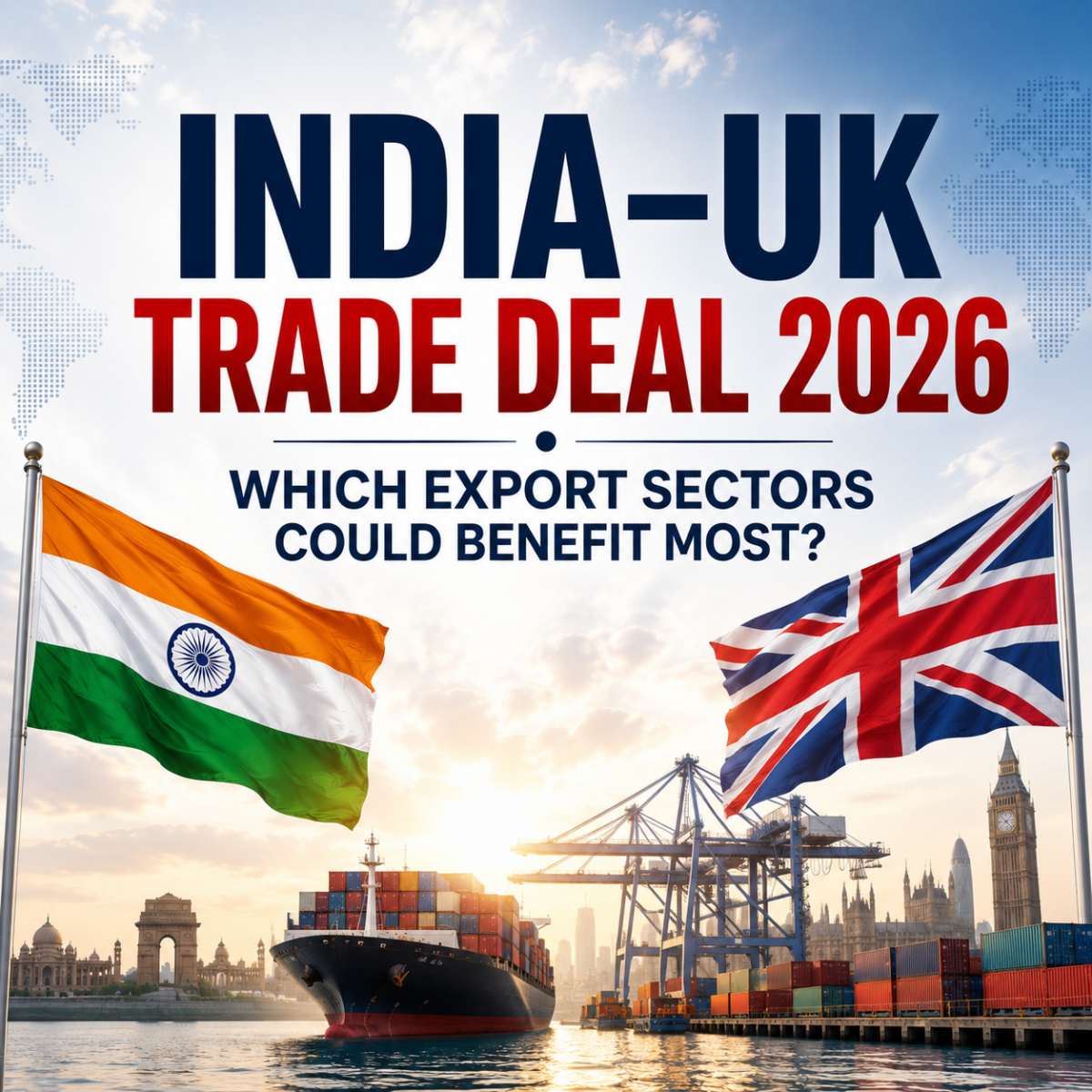
For Indian exporters, the UK market has just become significantly more interesting.
The India–UK Comprehensive Economic and Trade Agreement (CETA) officially entered into force on 15 July 2026, marking a major change in the trading relationship between the two countries.
The agreement gives Indian exporters preferential access to the UK market across a very large share of India’s export basket. India’s Ministry of Commerce says the deal provides duty-free access to nearly 99% of India’s exports to the UK, covering almost the entire value of bilateral goods trade.
That sounds impressive on paper.
But the more important question for businesses is: Which sectors are actually positioned to benefit?
The answer goes well beyond textiles or agriculture.
The agreement could influence everything from labour-intensive manufacturing and food products to pharmaceuticals, engineering, chemicals, automotive components, gems and jewellery, and the broader MSME export ecosystem.
For Indian businesses looking at international growth in 2026 and beyond, this is one of the trade developments worth watching closely.
What Exactly Changed with the India–UK CETA?
The agreement was signed in 2025, after years of negotiations, but its commercial provisions became operational when it entered into force on 15 July 2026. The UK government describes the agreement as a major step in strengthening bilateral trade and investment.
On the Indian side, the headline benefit is substantial tariff liberalisation.
According to India’s Ministry of Commerce, almost 99% of Indian exports to the UK receive duty-free access under the agreement, while several important Indian export sectors that previously faced tariffs now gain improved price competitiveness.
The agreement also covers services, investment, professional mobility, digital trade and other areas of economic cooperation.
So this isn’t simply a tariff-cutting exercise.
It is an attempt to make the India–UK commercial relationship broader and easier to operate over the long term.
Source: Ministry of Commerce & Industry, Government of India — India’s Free Trade Agreements (2025–26), Key Highlights — published March 2026.
Why the UK Market Matters to Indian Exporters
The UK is already an important trading partner for India.
India exported approximately US$13.44 billion in goods to the UK during 2025–26, while imports from the UK were approximately US$11.68 billion. India also maintained a services trade surplus with the UK.
The trade agreement changes the economics of that relationship.
For an exporter, even a relatively small tariff reduction can matter when competing against suppliers from countries that already enjoy preferential access.
Consider a UK importer comparing two suppliers.
If both suppliers offer similar quality, but one arrives with a lower duty burden, the difference can influence the purchasing decision.
Now imagine that advantage across thousands of shipments.
That’s where tariff liberalisation starts becoming commercially meaningful.
1. Textiles and Apparel: One of the Biggest Potential Winners
Textiles are among the sectors most closely associated with the India–UK trade opportunity.
India already has a large textile and apparel manufacturing ecosystem, covering cotton, yarn, fabrics, garments, home textiles and related products.
The CETA can improve the competitiveness of these products in the UK market by reducing or removing tariffs on qualifying exports. India’s Commerce Ministry specifically identifies textiles among the labour-intensive sectors expected to gain from the agreement.
For exporters, the opportunity isn’t simply about selling more garments.
There is potential for:
- Private-label clothing
- Home textiles
- Cotton products
- Technical textiles
- Sustainable fabrics
- Fashion accessories
- Contract manufacturing
However, tariff advantage alone won’t guarantee growth.
UK buyers increasingly care about sustainability, product consistency, labour standards, traceability, delivery reliability and documentation.
The exporters that combine competitive pricing with these capabilities are likely to have a stronger position.
2. Pharmaceuticals: A High-Value Opportunity
Pharmaceuticals are another important sector to watch.
India has one of the world’s largest generic pharmaceutical industries and already has substantial experience supplying regulated international markets.
The CETA’s improved market-access environment could help Indian pharmaceutical companies strengthen their position in the UK, although pharmaceutical exports remain highly dependent on regulatory approvals, quality systems and compliance requirements.
This is an important distinction.
A lower tariff doesn’t remove regulatory barriers.
A pharmaceutical exporter still needs to meet the relevant UK requirements before a product can be commercially successful.
For established Indian manufacturers with the necessary approvals and compliance infrastructure, however, improved trade terms can make the market more attractive.
The Indian government’s sector analysis identifies pharmaceuticals as one of the high-value sectors expected to benefit from the agreement.
3. Engineering Goods and Auto Components
India’s engineering export ecosystem is another area where the trade agreement could have a meaningful impact.
This includes:
- Machinery
- Industrial components
- Auto parts
- Electrical equipment
- Metal products
- Precision components
- Engineering assemblies
The UK government has highlighted advanced manufacturing as one of the sectors affected by the broader India–UK trade agreement, while Indian authorities have identified engineering goods and auto components among sectors with significant export potential.
This could be particularly relevant for Indian MSMEs.
A small engineering company that previously found the UK market difficult because of tariff costs may now be able to compete more effectively.
But winning UK buyers will still require technical documentation, quality certifications, dependable production capacity and consistent delivery.
4. Chemicals and Organic Chemicals
India’s chemical industry has become an important part of the country’s export economy.
The CETA specifically creates opportunities for several chemical and organic-chemical categories, with India’s Commerce Ministry identifying organic chemicals among sectors expected to gain from preferential access.
For chemical exporters, the UK market can be attractive because buyers often value long-term supply relationships.
However, this is also a sector where compliance is critical.
Product specifications, safety documentation, labelling, environmental requirements and regulatory compliance can influence whether a buyer is willing to switch suppliers.
The trade agreement may reduce one barrier—tariffs—but exporters still need to address the rest of the procurement equation.
5. Leather and Footwear
Leather and footwear are another labour-intensive sector with significant potential.
Indian manufacturers already have experience supplying international brands and distributors.
With improved UK market access, exporters may have an opportunity to compete more effectively in categories such as:
- Leather footwear
- Bags
- Wallets
- Accessories
- Finished leather
- Travel products
This sector also demonstrates an important point about modern exporting.
Price gets you considered. Compliance and consistency get you the order.
UK buyers increasingly evaluate suppliers on sustainability, material traceability, ethical production and quality control.
Indian manufacturers that can demonstrate these capabilities could be better positioned to capture the new market opportunity.
6. Gems and Jewellery
India has a long-established position in global gems and jewellery manufacturing and processing.
The UK is also an important consumer and trading market for jewellery.
The Commerce Ministry has identified gems and jewellery among India’s labour-intensive sectors that could gain from the CETA’s preferential access.
For exporters, opportunities could include:
- Finished jewellery
- Diamond jewellery
- Gold jewellery
- Precious and semi-precious stones
- Fashion jewellery
- Custom manufacturing
This sector is especially interesting because buyers often care about craftsmanship, design, certification and reliability—not simply the lowest price.
7. Agriculture and Food Processing
Agriculture deserves attention, but it needs to be viewed realistically.
The UK is a sophisticated food market with demanding standards.
The trade agreement can create opportunities for Indian agricultural and processed-food exporters by improving tariff access, but exporters still need to meet UK food-safety, labelling, traceability and quality requirements.
Potential areas include:
- Processed foods
- Spices
- Tea
- Coffee
- Rice
- Prepared food products
- Specialty foods
- Marine products
The Indian government has described the agreement as a major opportunity for agricultural exports, while recent industry analysis has highlighted agriculture and food-related sectors among areas expected to benefit.
For smaller exporters, this could be significant.
The UK has a large Indian-origin consumer market, but successful exporters should not rely only on diaspora demand. The bigger opportunity is building products that appeal to the wider UK retail and food-service market.
8. Marine Products and Food Processing
Marine products and processed foods also stand to benefit from improved market access.
These industries are already export-oriented and have experience dealing with international quality and food-safety requirements.
For seafood exporters, however, tariffs are only one part of the equation.
Cold-chain management, testing, traceability, packaging and regulatory compliance can determine whether an export shipment reaches the market successfully.
That means the CETA creates an opportunity—but businesses need the operational capability to use it.
9. Ceramics, Handicrafts and Artisanal Products
Not every opportunity will come from large corporations.
India’s small manufacturers and artisan-led businesses could also benefit.
The Commerce Ministry has specifically included artisanal products and ceramics among sectors expected to gain from the agreement.
For these businesses, the UK market could provide opportunities through:
- Home décor
- Handcrafted products
- Ceramics
- Tableware
- Decorative products
- Lifestyle products
- Giftware
Digital commerce makes this opportunity particularly interesting.
A small Indian manufacturer no longer necessarily needs a large UK physical distribution network to begin testing demand.
10. MSMEs Could Be the Hidden Beneficiaries
Perhaps the most important long-term effect of the India–UK trade agreement won’t be limited to the biggest exporters.
It could be the creation of new exporters.
A large company may already have international customers, compliance teams, freight partners and overseas offices.
A smaller manufacturer often doesn’t.
If tariff barriers become lower and market access becomes more predictable, some Indian MSMEs may find it easier to test the UK market.
This is why the CETA could have an impact beyond simply increasing export numbers.
It may encourage more Indian businesses to think internationally.
Recent analysis of the agreement has also highlighted this broader possibility: the creation of new export capabilities and new exporters could become one of the deal’s most important long-term effects.
But Zero Duty Does Not Mean Zero Requirements
This is probably the most important point for exporters to understand.
A headline such as “99% of Indian exports get duty-free access” does not mean that every shipment automatically enters the UK at zero duty.
Preferential treatment depends on the product qualifying under the agreement’s Rules of Origin.
The UK government explains that products generally need to be wholly obtained, produced using originating materials, or satisfy the relevant product-specific rules when non-originating materials are used.
That means exporters need to pay attention to:
- HS classification
- Product-specific origin rules
- Manufacturing processes
- Input sourcing
- Origin documentation
- Customs declarations
- Supporting records
A tariff benefit is valuable only if the exporter can successfully claim it.
Rules of Origin Could Become a Competitive Advantage
Rules of origin may sound like paperwork, but they can become commercially important.
Imagine two Indian exporters selling similar products.
Exporter A has clear documentation, understands the applicable origin rule and maintains proper production records.
Exporter B has a cheaper quotation but cannot confidently demonstrate that the goods qualify for preferential treatment.
The first exporter may ultimately be the more attractive supplier.
This is why export compliance should not be treated as an administrative afterthought.
Under the CETA, the rules of origin specifically determine whether goods can receive preferential tariffs. The UK government updated its official rules-of-origin guidance when the agreement entered into force on 15 July 2026.
What Should Indian Exporters Do Now?
The trade agreement creates an opportunity, but exporters need to act on it.
Review Your Product’s HS Code
Start by confirming the correct classification of every product you plan to export to the UK.
Tariff treatment and product-specific rules depend on classification.
Check the Applicable Origin Rule
Don’t assume your product automatically qualifies for preferential duty.
Review the relevant CETA origin rule for the exact product.
Recalculate Your UK Pricing
This is where the agreement becomes commercially interesting.
If your product previously carried an import tariff, calculate how the new treatment changes your buyer’s landed cost.
Then use that advantage intelligently.
You don’t necessarily need to reduce your selling price by the entire tariff saving.
Part of the benefit can improve your margin, while another part can make your quotation more competitive.
Review Your Packaging and Labelling
UK buyers have their own regulatory and commercial expectations.
Make sure your packaging, labelling and documentation are appropriate for the market.
Approach New UK Buyers
The agreement creates a natural reason to restart conversations with UK importers, distributors and procurement teams.
Instead of sending a generic sales email, explain the commercial relevance of the new trade environment and why your product may now be more competitive.
What UK Buyers Should Look for in Indian Suppliers
The trade agreement is not only good news for Indian exporters.
It can also create new sourcing opportunities for UK companies.
UK buyers may now want to reassess Indian suppliers they previously considered too expensive because of tariff costs.
But buyers should still evaluate:
- Product quality
- Certifications
- Production capacity
- Delivery reliability
- Documentation
- Origin eligibility
- Packaging
- Payment terms
- Freight arrangements
- Supplier track record
A lower tariff doesn’t automatically make a poor supplier a good supplier.
The fundamentals of procurement still matter.
India–UK Trade Could Become More Competitive
The biggest change may be the competitive landscape.
Indian suppliers are now in a stronger position to compete with exporters from other major manufacturing countries in sectors where tariffs previously affected the landed price.
That doesn’t mean India will suddenly replace existing suppliers.
International procurement decisions are rarely that simple.
Buyers consider quality, lead times, capacity, compliance, financing, relationships and geopolitical risk alongside price.
But when two suppliers are already competitive on those factors, tariff savings can become the deciding factor.
The Opportunity Is Bigger Than One Trade Agreement
There is a broader story here.
India has been pursuing trade agreements as part of a wider strategy to expand market access and integrate Indian businesses more deeply into global supply chains.
The UK agreement is therefore important not only because of the UK market itself, but because it demonstrates how trade policy can influence the competitiveness of Indian businesses.
For exporters, this means international trade strategy should no longer be based only on where demand exists today.
It should also consider where market access is improving.
What Could Hold Exporters Back?
The agreement does not remove every challenge.
Indian exporters still need to deal with:
- UK regulatory standards
- Product certification
- Sustainability expectations
- Logistics costs
- Currency fluctuations
- Quality consistency
- Rules of origin
- Documentation
- Strong international competition
There is also a risk of assuming that tariff reduction automatically creates orders.
It doesn’t.
A UK buyer still needs a reason to choose your company.
The exporters most likely to benefit will be those that combine the tariff advantage with quality, reliability, compliance and strong commercial execution.
What This Means for Indian Exporters in 2026
The India–UK CETA arrives at an interesting moment for global trade.
Companies around the world are reconsidering supply chains because of tariffs, geopolitical uncertainty, shipping disruptions and changing trade relationships.
In that environment, better market access can be a significant advantage.
For Indian exporters, the UK can become more than another destination.
It can become a strategic market for building international credibility, developing new customers and expanding into higher-value export segments.
Frequently Asked Questions
When did the India–UK Trade Deal come into effect?
The India–UK Comprehensive Economic and Trade Agreement (CETA) entered into force on 15 July 2026. The agreement was signed in 2025 after negotiations between the two countries.
How many Indian exports receive duty-free access to the UK?
India’s Ministry of Commerce states that CETA provides duty-free access to nearly 99% of India’s exports to the UK, covering almost the entire value of bilateral trade.
Which Indian sectors could benefit most?
Major potential beneficiaries include textiles, leather and footwear, gems and jewellery, pharmaceuticals, engineering goods, auto components, chemicals, processed foods, agriculture, marine products, ceramics and artisanal products.
Does every Indian product automatically get zero duty?
No. Preferential treatment depends on the specific product and whether it meets the applicable CETA Rules of Origin and other customs requirements.
Can Indian MSMEs benefit from the UK trade agreement?
Yes. Improved market access can create opportunities for smaller Indian manufacturers and exporters, particularly in labour-intensive manufacturing, food, engineering, textiles and specialty products. However, MSMEs still need to meet UK regulatory and buyer requirements.
Is the UK now a more attractive market for Indian exporters?
For many sectors, yes. Lower or zero tariffs can improve the landed-price competitiveness of qualifying Indian products. But the commercial benefit depends on product category, origin eligibility, compliance, logistics and buyer demand.
Final Thoughts
The India–UK Trade Deal is important not because it guarantees more exports overnight, but because it changes the conditions under which Indian companies compete in one of the world’s major developed markets.
For some exporters, the immediate benefit will be lower tariffs.
For others, it may be the chance to approach UK buyers who were previously difficult to compete for.
And for India’s MSMEs, the biggest opportunity may be even broader: becoming exporters in the first place.
The businesses that benefit most will not necessarily be the ones that simply announce “zero duty.”
They will be the ones that understand the agreement, verify their Rules of Origin, maintain strong documentation, meet UK standards and use the tariff advantage to build a genuinely competitive offer.
The India–UK trade relationship has entered a new phase.
For Indian exporters willing to prepare properly, 2026 could be the beginning of a much larger opportunity in the UK market.