Everything you need, right where you are

  • Ahmedabad, India
  • +91 99784 44291
Categories
Uncategorized

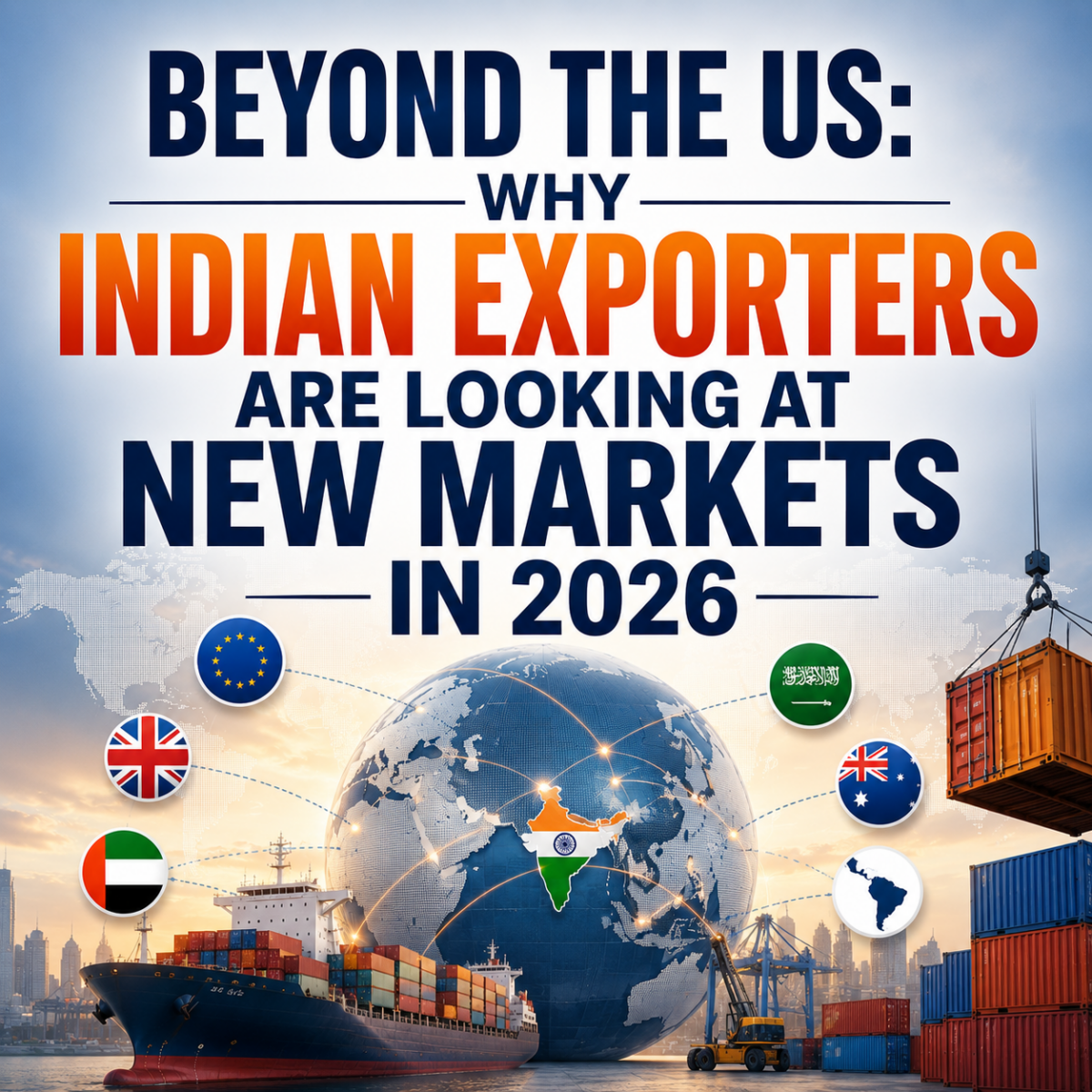
Beyond the US: Why Indian Exporters Are Looking at New Markets in 2026

For years, the United States has been one of the most important destinations for Indian exporters.

From textiles and garments to engineering goods, pharmaceuticals, jewellery, chemicals and other manufactured products, American buyers have played a major role in India’s export story.

But 2026 is changing the way many Indian businesses think about international trade.

Tariff uncertainty, geopolitical tensions and changing trade policies are pushing exporters to ask a different question:

What happens if one market becomes more difficult?

The answer emerging from India’s export sector is increasingly clear:

Build more markets.

This doesn’t mean Indian exporters are abandoning the United States. The U.S. remains a major commercial partner and an important destination for Indian products.

Instead, businesses are increasingly looking at Europe, the UK, the Middle East, Latin America, Australia, New Zealand and other markets as part of a more diversified export strategy.

And this shift is already visible in the market.


Why Export Diversification Has Become So Important

Exporting to one major market can be highly profitable.

It can also create concentration risk.

Imagine a manufacturer where 60–70% of international orders come from one country.

If tariffs increase, regulations change, consumer demand falls or geopolitical tensions affect trade, the impact can be immediate.

A diversified exporter has a different structure.

Instead of relying on one market, it may have:

  • Buyers in the US
  • Distributors in Europe
  • Customers in the UK
  • Trading partners in the UAE
  • Buyers in Saudi Arabia
  • Customers in Australia
  • Emerging markets in Africa or Latin America

The individual markets may not all be equally large.

But together, they create resilience.

This is becoming particularly important in 2026 as trade policy becomes a bigger factor in international business decisions.


The US Is Still Important — But It Is Not the Only Market

India’s merchandise exports to the United States reached approximately US$87.3 billion in FY 2025–26, compared with US$86.5 billion in FY 2024–25. Despite tariff-related uncertainty, Indian exports to the US continued to grow.

That is important.

The story isn’t that the US market has suddenly become irrelevant.

It hasn’t.

Indian products continue to have strong demand in the United States, particularly in labour-intensive sectors where India remains competitive.

The more accurate story is that exporters are beginning to balance their exposure.

A company can continue selling to America while simultaneously building customers in Europe or the Middle East.

That is a much more realistic form of diversification.


A New $200 Billion Opportunity Is Being Discussed

A recent analysis has brought the diversification discussion into sharper focus.

Economist S.P. Sharma, speaking to ANI, said Indian exporters could potentially target around 15 alternative markets for products currently sold to the US.

He estimated that these markets together could represent approximately US$200 billion of potential demand for similar Indian products.

Markets mentioned include:

  • Netherlands
  • France
  • United Kingdom
  • Saudi Arabia
  • United Arab Emirates
  • Nepal
  • Countries across Latin America

The estimate is an economist’s assessment, not a guaranteed export opportunity or an official government target. It is better understood as an indication of the scale of markets available if Indian exporters successfully diversify their customer base.

That distinction matters.

A $200 billion market does not mean India can immediately replace US exports with the same value elsewhere.

Market access, demand, competition, certifications, logistics and buyer relationships all take time.

But the opportunity is large enough to deserve attention.


Europe Is Emerging as One of the Biggest Alternatives

Europe is particularly interesting for Indian exporters in 2026.

India’s trade relationship with European markets has been gaining momentum through new trade arrangements and stronger supply-chain interest.

The European market also offers something exporters value:

diversification across multiple countries.

Selling into Europe doesn’t mean depending on a single country.

An Indian exporter can potentially build business across:

  • Germany
  • France
  • Netherlands
  • Italy
  • Spain
  • Poland
  • Belgium
  • Other European markets

This creates a broader customer base.

And there is already evidence that some Indian companies are moving in this direction.


A Real-World Example: Raymond Lifestyle

A recent Reuters report provides a useful example.

Indian apparel company Raymond Lifestyle said on 11 August 2026 that it expects Europe to account for approximately 20–25% of its exports within two years, up from around 17% before recent tariff disruptions.

At the same time, the company’s U.S. share is expected to decline from around 65% to approximately 55–60%.

The company reported that European enquiries had increased following recent India–UK and India–Europe trade developments, with new customers emerging in countries including the UK, Poland, Germany and France.

This is an important example because it shows what diversification looks like in practice.

The company isn’t saying:

“We are leaving America.”

It is saying:

“We want more than one major market.”

That is a very different strategy.


India–UK Trade Deal Adds Another Advantage

The United Kingdom has become particularly important for Indian exporters.

The India–UK Comprehensive Economic and Trade Agreement entered into force in July 2026 and provides preferential access covering nearly 99% of India’s exports to the UK, according to India’s Ministry of Commerce.

That creates opportunities across sectors such as:

  • Textiles
  • Apparel
  • Leather
  • Footwear
  • Engineering products
  • Pharmaceuticals
  • Chemicals
  • Gems and jewellery
  • Processed foods
  • Ceramics
  • Auto components

For Indian exporters, the UK can therefore serve two purposes.

It is a market in its own right.

And it can also become a strategic gateway for businesses building stronger European relationships.


The Middle East Is Becoming More Important Too

The Middle East has long been an important destination for Indian exports.

But its role is evolving.

The region is not only a consumer market.

Countries such as the UAE and Saudi Arabia also function as major trading, logistics and re-export hubs.

For Indian exporters, this can create multiple opportunities.

A shipment to the UAE may ultimately reach customers across a wider region.

The UAE’s trade relationship with India has already demonstrated the potential of preferential trade agreements.

India’s Commerce Ministry has reported significant export diversification following the India-UAE CEPA, including an increase in the number of product lines exported.

For exporters looking at new markets, that is an important lesson:

A good export destination can also provide access to surrounding markets.


Saudi Arabia: More Than an Oil Market

Saudi Arabia is increasingly becoming relevant to Indian exporters beyond traditional commodity trade.

The country’s economic transformation is creating demand across:

  • Construction
  • Food
  • Engineering
  • Industrial products
  • Consumer goods
  • Healthcare
  • Technology
  • Infrastructure-related products

For Indian manufacturers, the opportunity is not necessarily about competing only on price.

The larger opportunity is to become a dependable supplier to a rapidly developing market.

That means exporters need to understand local distributors, procurement structures, certifications and payment practices.


Why the Netherlands Matters

The Netherlands may look like a relatively small market compared with the United States.

But from a logistics perspective, it is much more important than its population suggests.

The country is one of Europe’s major trade and logistics hubs.

For exporters, access to the Netherlands can potentially provide a route into broader European distribution networks.

That makes it particularly relevant for businesses selling:

  • Industrial goods
  • Chemicals
  • Food products
  • Machinery
  • Textiles
  • Consumer products
  • Agricultural commodities

An exporter should therefore evaluate a country not only by its domestic demand.

Look at its role in the wider supply chain.


France and Germany Offer High-Value Opportunities

France and Germany are two markets that Indian exporters should watch closely.

Germany is particularly important for:

  • Engineering
  • Machinery
  • Auto components
  • Chemicals
  • Industrial products
  • Electronics

France offers opportunities across:

  • Fashion
  • Textiles
  • Food
  • Engineering
  • Aerospace-related supply chains
  • Consumer products

These are competitive markets.

European buyers often have strict expectations around quality, documentation, sustainability and delivery.

That can make entry more difficult.

But once an exporter establishes credibility, the customer relationship can become significantly more valuable.


Latin America Could Become the Next Frontier

Latin America is another region that deserves more attention.

Markets such as Brazil, Mexico, Chile, Colombia and Peru have large consumer bases and growing industrial demand.

Indian exporters already have experience in some of these markets, but there is room for deeper penetration.

Potential opportunities include:

  • Pharmaceuticals
  • Chemicals
  • Machinery
  • Automotive components
  • Textiles
  • Agricultural products
  • Engineering goods

The challenge is logistics.

Long shipping distances, local regulations, language differences and distribution networks can make market entry more complex.

That means Latin America may be more suitable for exporters willing to build a long-term strategy rather than simply chase quick orders.


The Exporter Mindset Is Changing

The old approach to exporting was often:

Find one buyer → get repeat orders → keep supplying.

That model can work.

But in a volatile global environment, exporters increasingly need another layer:

Build a portfolio of markets.

For example, a manufacturer might have:

35% Europe
25% US
15% Middle East
10% UK
10% Asia
5% other markets

The exact numbers will depend on the business.

The point is not to create an artificial formula.

The point is to avoid allowing one destination to control the company’s entire international revenue.


Diversification Is Not Just About Geography

There is another mistake exporters can make.

They diversify countries but not customers.

Suppose a company sells to five countries but 70% of its total export revenue still comes from one large buyer.

That is not genuine diversification.

A stronger export strategy considers three levels:

Market Diversification

Sell across multiple countries.

Customer Diversification

Avoid excessive dependence on one buyer.

Product Diversification

Develop products for different market segments.

Together, these create a more resilient export business.


Trade Agreements Can Accelerate Diversification

Trade agreements can make this process easier.

Tariff reductions can improve the landed cost of Indian products.

But the real benefit is broader.

A trade agreement can give exporters a reason to approach buyers who previously considered Indian products less competitive.

India has been expanding its network of trade agreements and working to improve the utilisation of existing agreements.

Government documents show that India has signed multiple FTAs and PTAs and is encouraging exporters to make better use of preferential market access.

This means exporters should not treat an FTA as something only large corporations need to understand.

It can matter to an MSME selling a few containers a month just as much.


But Tariff Reduction Alone Won’t Create Buyers

This is where many export discussions become unrealistic.

Suppose a tariff falls from 10% to zero.

That is good news.

But if the exporter has:

  • Poor packaging
  • Slow response times
  • Weak documentation
  • Inconsistent quality
  • No certifications
  • Unreliable delivery
  • No local distribution strategy

the tariff advantage may not be enough.

A buyer doesn’t purchase a product because it has zero duty.

The buyer purchases because the overall commercial proposition makes sense.

Price is one part of that equation.


What UK and European Buyers Are Looking For

For Indian exporters targeting Europe and the UK, expectations are becoming more sophisticated.

Buyers increasingly evaluate:

Quality Consistency

Can the exporter deliver the same specification every time?

Documentation

Are certificates, technical sheets, invoices and shipping documents accurate?

Traceability

Can the exporter explain where the product comes from and how it was produced?

Sustainability

Can the supplier meet the buyer’s environmental and social expectations?

Delivery Reliability

Can the exporter meet the agreed shipment schedule?

Communication

Does the supplier respond quickly and professionally?

These factors can determine whether an initial enquiry becomes a long-term account.


Why MSMEs Need to Pay Attention

Large exporters usually have teams for:

  • International sales
  • Compliance
  • Logistics
  • Finance
  • Market research
  • Legal documentation

Smaller exporters often don’t.

That can make diversification harder.

But digital tools are changing the equation.

A small Indian manufacturer can now:

  • Research foreign buyers
  • Analyse competitors
  • Build multilingual catalogues
  • Contact distributors
  • Track enquiries
  • Monitor trade data
  • Compare tariffs
  • Create professional product presentations

The technology is increasingly available.

The challenge is using it systematically.


A Practical Strategy for Indian Exporters

If you’re currently dependent on one major market, don’t try to enter ten new countries at once.

Start with three.

Step 1: Identify Your Best Alternative Markets

Look for countries already importing products similar to yours.

Step 2: Compare Tariffs

Check the applicable tariff and whether an FTA or preferential arrangement exists.

Step 3: Study Regulations

Determine the certifications, labelling and product standards required.

Step 4: Calculate Landed Cost

Don’t compare only your FOB price.

Understand freight, insurance, duty, taxes and local costs.

Step 5: Build a Buyer List

Target importers, distributors, manufacturers and wholesalers rather than sending generic messages to random companies.

Step 6: Test the Market

Start with small orders or trial shipments where commercially appropriate.

Step 7: Build Repeat Business

The goal is not simply to get one container order.

It is to create a reliable customer relationship.


What Could Go Wrong With Diversification?

Diversification sounds attractive, but it isn’t risk-free.

Entering a new market requires investment.

You may need:

  • New certifications
  • New packaging
  • Local agents
  • Product modifications
  • Longer payment cycles
  • Additional working capital
  • Market-specific marketing

There is also a risk of spreading the sales team too thin.

A company chasing 15 countries without understanding any of them deeply may perform worse than a company focused on three well-selected markets.

So diversification should be strategic, not random.


The Biggest Opportunity May Be in Existing Products

One of the most interesting ideas from the current diversification discussion is that Indian exporters may not always need to invent new products.

They can often sell existing products to new markets.

If a company already exports successfully to the US, it has proof that:

  • The product has international demand
  • The manufacturing system works
  • The company understands export logistics
  • Quality standards can be maintained

The next step may simply be finding similar buyers elsewhere.

This can be much faster than developing an entirely new product.


What This Means for India’s Export Future

India’s record US$863.1 billion total exports in FY 2025–26 shows that the country’s export base is already broadening across goods and services.

The next stage may be about improving the quality of that growth.

More markets.

More products.

More buyers.

More value-added exports.

And stronger integration into global supply chains.

The recent diversification discussion suggests that Indian exporters have significant room to expand beyond traditional destinations.

But the opportunity will belong to businesses that are prepared.


The Real Lesson for Indian Exporters

The current global trade environment has made one thing clear:

Dependence is expensive. Diversification is a form of protection.

The United States will remain an important market for India.

Europe will matter.

The UK will matter.

The Middle East will matter.

Asia, Africa and Latin America will matter.

The winning strategy is unlikely to be choosing one over another.

It will be building a business that can operate across several markets and adapt when global trade conditions change.

For an Indian exporter, that means the question is no longer:

“Where can I sell my product?”

It is:

“How many strong international markets can I build for my product?”

That shift in mindset could become one of the defining features of Indian exports in 2026 and beyond.


Frequently Asked Questions

Why are Indian exporters looking beyond the US?

Tariff uncertainty and changing global trade policies have encouraged exporters to reduce excessive dependence on any single market. The goal is generally diversification rather than abandoning the US market.

Which alternative markets are being discussed?

Recent analysis has highlighted markets including the Netherlands, France, the UK, Saudi Arabia, the UAE, Nepal and countries in Latin America.

Is there really a $200 billion alternative export market?

Economist S.P. Sharma estimated that 15 alternative markets could represent around $200 billion of potential demand for products India currently exports to the US. This is an expert estimate, not an official government forecast or guaranteed market size.

Is India leaving the US export market?

No. The US remains a major destination for Indian merchandise exports. Diversification means building additional markets while maintaining viable existing business relationships.

Why is Europe becoming more attractive?

Recent India–Europe and India–UK trade developments can improve market access and competitiveness. Companies are also responding to changing global supply-chain strategies. Reuters reported increased European interest among Indian apparel exporters in August 2026.

Which Indian exporters can benefit from diversification?

Potential beneficiaries include manufacturers and traders across textiles, engineering, pharmaceuticals, chemicals, food products, agricultural commodities, jewellery, leather, machinery, auto components and other internationally traded goods.

Should a small exporter enter 15 countries at once?

No. A better approach is to identify a few markets where the product already has demand, compare tariffs and regulations, and test those markets before expanding further.


Conclusion

The global export market is becoming harder to predict.

Tariffs can change.

Trade agreements can create new advantages.

Shipping routes can be disrupted.

Consumer demand can move from one region to another.

For Indian exporters, the answer is not to stop competing.

It is to become more flexible.

The US can remain a major customer.

Europe can become a growth engine.

The UK can offer preferential access.

The Middle East can provide regional distribution opportunities.

And emerging markets can create the next wave of demand.

The companies that start building these relationships today may be in a much stronger position tomorrow.

India’s next export opportunity may not be in one country. It may be in the ability to sell the same Indian product successfully across the world.
 

Sources & References
1. The Times of India
2. The Economic Times / ANI
3. Reuters
4. Ministry of Commerce & Industry, Government of India
5. Ministry of Commerce & Industry, Government of India
Categories
Uncategorized

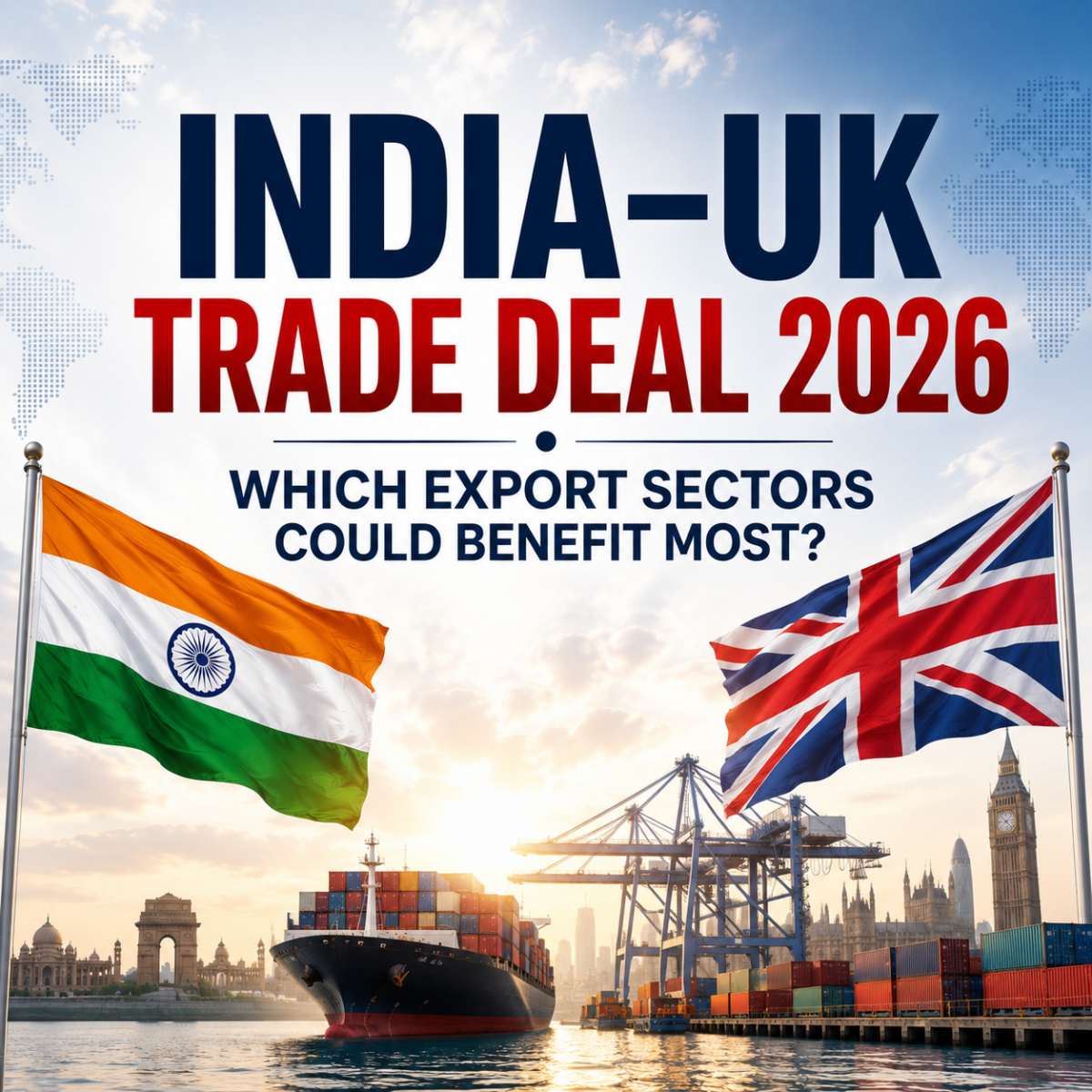
India–UK Trade Deal 2026: Export Sectors That Could Benefit Most

For Indian exporters, the UK market has just become significantly more interesting.

The India–UK Comprehensive Economic and Trade Agreement (CETA) officially entered into force on 15 July 2026, marking a major change in the trading relationship between the two countries.

The agreement gives Indian exporters preferential access to the UK market across a very large share of India’s export basket. India’s Ministry of Commerce says the deal provides duty-free access to nearly 99% of India’s exports to the UK, covering almost the entire value of bilateral goods trade.

That sounds impressive on paper.

But the more important question for businesses is: Which sectors are actually positioned to benefit?

The answer goes well beyond textiles or agriculture.

The agreement could influence everything from labour-intensive manufacturing and food products to pharmaceuticals, engineering, chemicals, automotive components, gems and jewellery, and the broader MSME export ecosystem.

For Indian businesses looking at international growth in 2026 and beyond, this is one of the trade developments worth watching closely.


What Exactly Changed with the India–UK CETA?

The agreement was signed in 2025, after years of negotiations, but its commercial provisions became operational when it entered into force on 15 July 2026. The UK government describes the agreement as a major step in strengthening bilateral trade and investment.

On the Indian side, the headline benefit is substantial tariff liberalisation.

According to India’s Ministry of Commerce, almost 99% of Indian exports to the UK receive duty-free access under the agreement, while several important Indian export sectors that previously faced tariffs now gain improved price competitiveness.

The agreement also covers services, investment, professional mobility, digital trade and other areas of economic cooperation.

So this isn’t simply a tariff-cutting exercise.

It is an attempt to make the India–UK commercial relationship broader and easier to operate over the long term.

Source: Ministry of Commerce & Industry, Government of India — India’s Free Trade Agreements (2025–26), Key Highlights — published March 2026.


Why the UK Market Matters to Indian Exporters

The UK is already an important trading partner for India.

India exported approximately US$13.44 billion in goods to the UK during 2025–26, while imports from the UK were approximately US$11.68 billion. India also maintained a services trade surplus with the UK.

The trade agreement changes the economics of that relationship.

For an exporter, even a relatively small tariff reduction can matter when competing against suppliers from countries that already enjoy preferential access.

Consider a UK importer comparing two suppliers.

If both suppliers offer similar quality, but one arrives with a lower duty burden, the difference can influence the purchasing decision.

Now imagine that advantage across thousands of shipments.

That’s where tariff liberalisation starts becoming commercially meaningful.


1. Textiles and Apparel: One of the Biggest Potential Winners

Textiles are among the sectors most closely associated with the India–UK trade opportunity.

India already has a large textile and apparel manufacturing ecosystem, covering cotton, yarn, fabrics, garments, home textiles and related products.

The CETA can improve the competitiveness of these products in the UK market by reducing or removing tariffs on qualifying exports. India’s Commerce Ministry specifically identifies textiles among the labour-intensive sectors expected to gain from the agreement.

For exporters, the opportunity isn’t simply about selling more garments.

There is potential for:

  • Private-label clothing
  • Home textiles
  • Cotton products
  • Technical textiles
  • Sustainable fabrics
  • Fashion accessories
  • Contract manufacturing

However, tariff advantage alone won’t guarantee growth.

UK buyers increasingly care about sustainability, product consistency, labour standards, traceability, delivery reliability and documentation.

The exporters that combine competitive pricing with these capabilities are likely to have a stronger position.


2. Pharmaceuticals: A High-Value Opportunity

Pharmaceuticals are another important sector to watch.

India has one of the world’s largest generic pharmaceutical industries and already has substantial experience supplying regulated international markets.

The CETA’s improved market-access environment could help Indian pharmaceutical companies strengthen their position in the UK, although pharmaceutical exports remain highly dependent on regulatory approvals, quality systems and compliance requirements.

This is an important distinction.

A lower tariff doesn’t remove regulatory barriers.

A pharmaceutical exporter still needs to meet the relevant UK requirements before a product can be commercially successful.

For established Indian manufacturers with the necessary approvals and compliance infrastructure, however, improved trade terms can make the market more attractive.

The Indian government’s sector analysis identifies pharmaceuticals as one of the high-value sectors expected to benefit from the agreement.


3. Engineering Goods and Auto Components

India’s engineering export ecosystem is another area where the trade agreement could have a meaningful impact.

This includes:

  • Machinery
  • Industrial components
  • Auto parts
  • Electrical equipment
  • Metal products
  • Precision components
  • Engineering assemblies

The UK government has highlighted advanced manufacturing as one of the sectors affected by the broader India–UK trade agreement, while Indian authorities have identified engineering goods and auto components among sectors with significant export potential.

This could be particularly relevant for Indian MSMEs.

A small engineering company that previously found the UK market difficult because of tariff costs may now be able to compete more effectively.

But winning UK buyers will still require technical documentation, quality certifications, dependable production capacity and consistent delivery.


4. Chemicals and Organic Chemicals

India’s chemical industry has become an important part of the country’s export economy.

The CETA specifically creates opportunities for several chemical and organic-chemical categories, with India’s Commerce Ministry identifying organic chemicals among sectors expected to gain from preferential access.

For chemical exporters, the UK market can be attractive because buyers often value long-term supply relationships.

However, this is also a sector where compliance is critical.

Product specifications, safety documentation, labelling, environmental requirements and regulatory compliance can influence whether a buyer is willing to switch suppliers.

The trade agreement may reduce one barrier—tariffs—but exporters still need to address the rest of the procurement equation.


5. Leather and Footwear

Leather and footwear are another labour-intensive sector with significant potential.

Indian manufacturers already have experience supplying international brands and distributors.

With improved UK market access, exporters may have an opportunity to compete more effectively in categories such as:

  • Leather footwear
  • Bags
  • Wallets
  • Accessories
  • Finished leather
  • Travel products

This sector also demonstrates an important point about modern exporting.

Price gets you considered. Compliance and consistency get you the order.

UK buyers increasingly evaluate suppliers on sustainability, material traceability, ethical production and quality control.

Indian manufacturers that can demonstrate these capabilities could be better positioned to capture the new market opportunity.


6. Gems and Jewellery

India has a long-established position in global gems and jewellery manufacturing and processing.

The UK is also an important consumer and trading market for jewellery.

The Commerce Ministry has identified gems and jewellery among India’s labour-intensive sectors that could gain from the CETA’s preferential access.

For exporters, opportunities could include:

  • Finished jewellery
  • Diamond jewellery
  • Gold jewellery
  • Precious and semi-precious stones
  • Fashion jewellery
  • Custom manufacturing

This sector is especially interesting because buyers often care about craftsmanship, design, certification and reliability—not simply the lowest price.


7. Agriculture and Food Processing

Agriculture deserves attention, but it needs to be viewed realistically.

The UK is a sophisticated food market with demanding standards.

The trade agreement can create opportunities for Indian agricultural and processed-food exporters by improving tariff access, but exporters still need to meet UK food-safety, labelling, traceability and quality requirements.

Potential areas include:

  • Processed foods
  • Spices
  • Tea
  • Coffee
  • Rice
  • Prepared food products
  • Specialty foods
  • Marine products

The Indian government has described the agreement as a major opportunity for agricultural exports, while recent industry analysis has highlighted agriculture and food-related sectors among areas expected to benefit.

For smaller exporters, this could be significant.

The UK has a large Indian-origin consumer market, but successful exporters should not rely only on diaspora demand. The bigger opportunity is building products that appeal to the wider UK retail and food-service market.


8. Marine Products and Food Processing

Marine products and processed foods also stand to benefit from improved market access.

These industries are already export-oriented and have experience dealing with international quality and food-safety requirements.

For seafood exporters, however, tariffs are only one part of the equation.

Cold-chain management, testing, traceability, packaging and regulatory compliance can determine whether an export shipment reaches the market successfully.

That means the CETA creates an opportunity—but businesses need the operational capability to use it.


9. Ceramics, Handicrafts and Artisanal Products

Not every opportunity will come from large corporations.

India’s small manufacturers and artisan-led businesses could also benefit.

The Commerce Ministry has specifically included artisanal products and ceramics among sectors expected to gain from the agreement.

For these businesses, the UK market could provide opportunities through:

  • Home décor
  • Handcrafted products
  • Ceramics
  • Tableware
  • Decorative products
  • Lifestyle products
  • Giftware

Digital commerce makes this opportunity particularly interesting.

A small Indian manufacturer no longer necessarily needs a large UK physical distribution network to begin testing demand.


10. MSMEs Could Be the Hidden Beneficiaries

Perhaps the most important long-term effect of the India–UK trade agreement won’t be limited to the biggest exporters.

It could be the creation of new exporters.

A large company may already have international customers, compliance teams, freight partners and overseas offices.

A smaller manufacturer often doesn’t.

If tariff barriers become lower and market access becomes more predictable, some Indian MSMEs may find it easier to test the UK market.

This is why the CETA could have an impact beyond simply increasing export numbers.

It may encourage more Indian businesses to think internationally.

Recent analysis of the agreement has also highlighted this broader possibility: the creation of new export capabilities and new exporters could become one of the deal’s most important long-term effects.


But Zero Duty Does Not Mean Zero Requirements

This is probably the most important point for exporters to understand.

A headline such as “99% of Indian exports get duty-free access” does not mean that every shipment automatically enters the UK at zero duty.

Preferential treatment depends on the product qualifying under the agreement’s Rules of Origin.

The UK government explains that products generally need to be wholly obtained, produced using originating materials, or satisfy the relevant product-specific rules when non-originating materials are used.

That means exporters need to pay attention to:

  • HS classification
  • Product-specific origin rules
  • Manufacturing processes
  • Input sourcing
  • Origin documentation
  • Customs declarations
  • Supporting records

A tariff benefit is valuable only if the exporter can successfully claim it.


Rules of Origin Could Become a Competitive Advantage

Rules of origin may sound like paperwork, but they can become commercially important.

Imagine two Indian exporters selling similar products.

Exporter A has clear documentation, understands the applicable origin rule and maintains proper production records.

Exporter B has a cheaper quotation but cannot confidently demonstrate that the goods qualify for preferential treatment.

The first exporter may ultimately be the more attractive supplier.

This is why export compliance should not be treated as an administrative afterthought.

Under the CETA, the rules of origin specifically determine whether goods can receive preferential tariffs. The UK government updated its official rules-of-origin guidance when the agreement entered into force on 15 July 2026.


What Should Indian Exporters Do Now?

The trade agreement creates an opportunity, but exporters need to act on it.

Review Your Product’s HS Code

Start by confirming the correct classification of every product you plan to export to the UK.

Tariff treatment and product-specific rules depend on classification.

Check the Applicable Origin Rule

Don’t assume your product automatically qualifies for preferential duty.

Review the relevant CETA origin rule for the exact product.

Recalculate Your UK Pricing

This is where the agreement becomes commercially interesting.

If your product previously carried an import tariff, calculate how the new treatment changes your buyer’s landed cost.

Then use that advantage intelligently.

You don’t necessarily need to reduce your selling price by the entire tariff saving.

Part of the benefit can improve your margin, while another part can make your quotation more competitive.

Review Your Packaging and Labelling

UK buyers have their own regulatory and commercial expectations.

Make sure your packaging, labelling and documentation are appropriate for the market.

Approach New UK Buyers

The agreement creates a natural reason to restart conversations with UK importers, distributors and procurement teams.

Instead of sending a generic sales email, explain the commercial relevance of the new trade environment and why your product may now be more competitive.


What UK Buyers Should Look for in Indian Suppliers

The trade agreement is not only good news for Indian exporters.

It can also create new sourcing opportunities for UK companies.

UK buyers may now want to reassess Indian suppliers they previously considered too expensive because of tariff costs.

But buyers should still evaluate:

  • Product quality
  • Certifications
  • Production capacity
  • Delivery reliability
  • Documentation
  • Origin eligibility
  • Packaging
  • Payment terms
  • Freight arrangements
  • Supplier track record

A lower tariff doesn’t automatically make a poor supplier a good supplier.

The fundamentals of procurement still matter.


India–UK Trade Could Become More Competitive

The biggest change may be the competitive landscape.

Indian suppliers are now in a stronger position to compete with exporters from other major manufacturing countries in sectors where tariffs previously affected the landed price.

That doesn’t mean India will suddenly replace existing suppliers.

International procurement decisions are rarely that simple.

Buyers consider quality, lead times, capacity, compliance, financing, relationships and geopolitical risk alongside price.

But when two suppliers are already competitive on those factors, tariff savings can become the deciding factor.


The Opportunity Is Bigger Than One Trade Agreement

There is a broader story here.

India has been pursuing trade agreements as part of a wider strategy to expand market access and integrate Indian businesses more deeply into global supply chains.

The UK agreement is therefore important not only because of the UK market itself, but because it demonstrates how trade policy can influence the competitiveness of Indian businesses.

For exporters, this means international trade strategy should no longer be based only on where demand exists today.

It should also consider where market access is improving.


What Could Hold Exporters Back?

The agreement does not remove every challenge.

Indian exporters still need to deal with:

  • UK regulatory standards
  • Product certification
  • Sustainability expectations
  • Logistics costs
  • Currency fluctuations
  • Quality consistency
  • Rules of origin
  • Documentation
  • Strong international competition

There is also a risk of assuming that tariff reduction automatically creates orders.

It doesn’t.

A UK buyer still needs a reason to choose your company.

The exporters most likely to benefit will be those that combine the tariff advantage with quality, reliability, compliance and strong commercial execution.


What This Means for Indian Exporters in 2026

The India–UK CETA arrives at an interesting moment for global trade.

Companies around the world are reconsidering supply chains because of tariffs, geopolitical uncertainty, shipping disruptions and changing trade relationships.

In that environment, better market access can be a significant advantage.

For Indian exporters, the UK can become more than another destination.

It can become a strategic market for building international credibility, developing new customers and expanding into higher-value export segments.


Frequently Asked Questions

When did the India–UK Trade Deal come into effect?

The India–UK Comprehensive Economic and Trade Agreement (CETA) entered into force on 15 July 2026. The agreement was signed in 2025 after negotiations between the two countries.

How many Indian exports receive duty-free access to the UK?

India’s Ministry of Commerce states that CETA provides duty-free access to nearly 99% of India’s exports to the UK, covering almost the entire value of bilateral trade.

Which Indian sectors could benefit most?

Major potential beneficiaries include textiles, leather and footwear, gems and jewellery, pharmaceuticals, engineering goods, auto components, chemicals, processed foods, agriculture, marine products, ceramics and artisanal products.

Does every Indian product automatically get zero duty?

No. Preferential treatment depends on the specific product and whether it meets the applicable CETA Rules of Origin and other customs requirements.

Can Indian MSMEs benefit from the UK trade agreement?

Yes. Improved market access can create opportunities for smaller Indian manufacturers and exporters, particularly in labour-intensive manufacturing, food, engineering, textiles and specialty products. However, MSMEs still need to meet UK regulatory and buyer requirements.

Is the UK now a more attractive market for Indian exporters?

For many sectors, yes. Lower or zero tariffs can improve the landed-price competitiveness of qualifying Indian products. But the commercial benefit depends on product category, origin eligibility, compliance, logistics and buyer demand.


Final Thoughts

The India–UK Trade Deal is important not because it guarantees more exports overnight, but because it changes the conditions under which Indian companies compete in one of the world’s major developed markets.

For some exporters, the immediate benefit will be lower tariffs.

For others, it may be the chance to approach UK buyers who were previously difficult to compete for.

And for India’s MSMEs, the biggest opportunity may be even broader: becoming exporters in the first place.

The businesses that benefit most will not necessarily be the ones that simply announce “zero duty.”

They will be the ones that understand the agreement, verify their Rules of Origin, maintain strong documentation, meet UK standards and use the tariff advantage to build a genuinely competitive offer.

The India–UK trade relationship has entered a new phase.

For Indian exporters willing to prepare properly, 2026 could be the beginning of a much larger opportunity in the UK market.


Categories
Uncategorized

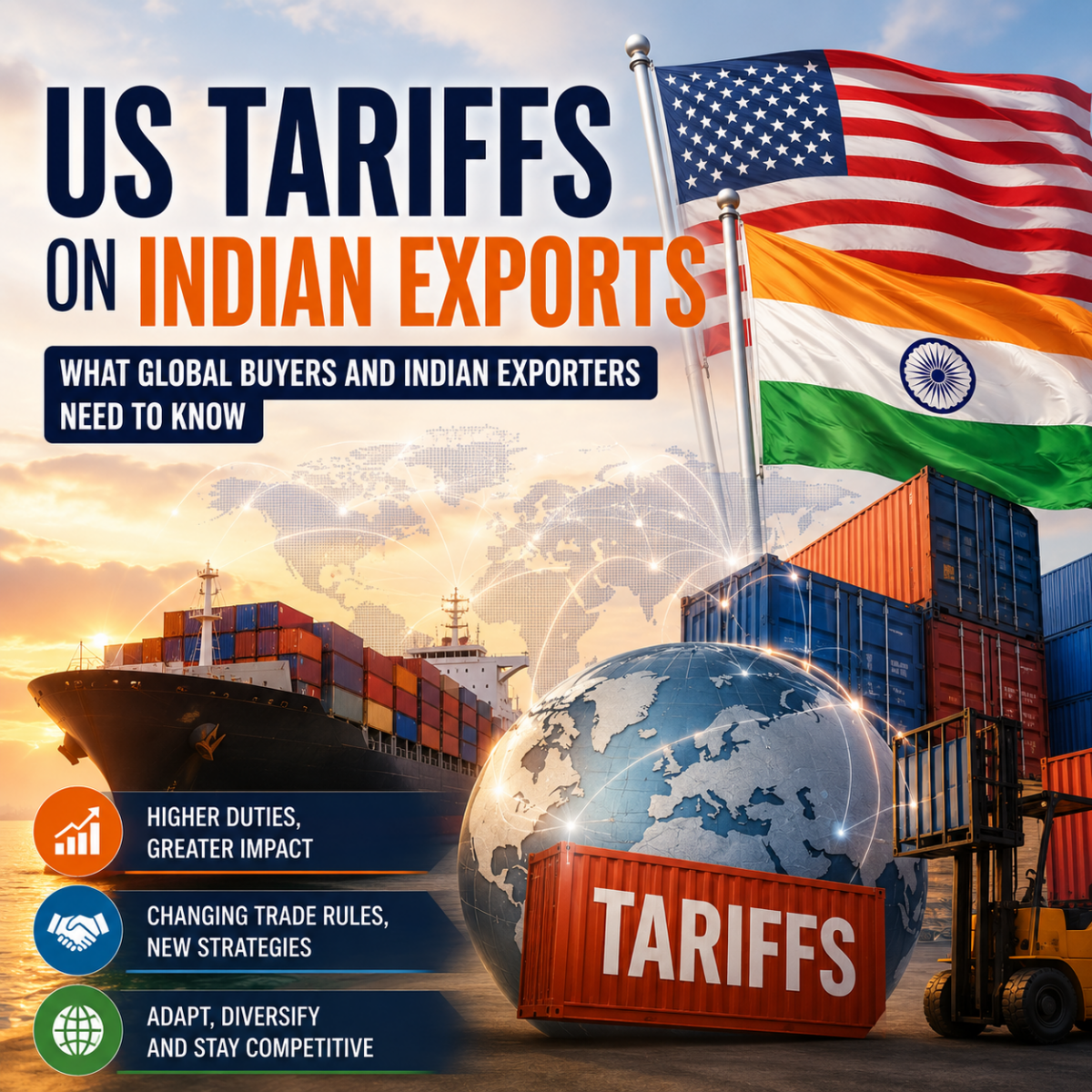
US Tariffs on Indian Exports in 2026: What Global Buyers and Indian Exporters Need to Know

Understand how US tariffs are affecting Indian exports in 2026, what they mean for exporters and global buyers, and how businesses can adapt to changing trade conditions.

International trade has become harder to predict.

For years, exporters could largely plan around established tariff structures, established trade routes, and relatively stable market access. In 2026, that assumption is becoming increasingly difficult to maintain.

The latest U.S. tariff measures affecting Indian goods are a good example.

The United States remains one of India’s most important export markets, but changing tariff rules are forcing exporters and American buyers to rethink pricing, sourcing, contracts, and supply-chain strategy.

The situation is also more complicated than simply saying that “Indian goods now face a higher tariff.” Different products can fall under different U.S. tariff measures, and a substantial portion of India’s exports to the U.S. is outside the latest additional duty.

For businesses involved in international trade, understanding that distinction is essential.


What Has Changed in US–India Trade in 2026?

The tariff relationship between India and the United States has gone through several changes during 2026.

An earlier temporary 10% U.S. tariff under Section 122 expired on July 24, 2026. It was followed by a new tariff framework, including an additional 10% duty under Section 301 related to concerns over forced labour in supply chains.

According to India’s Commerce Ministry, approximately 45% of India’s exports to the United States remain outside this additional 10% duty. Products already covered by certain Section 232 measures, including steel, aluminium and auto parts, are among the categories treated differently under the new arrangement.

That distinction matters.

An exporter should not assume that every Indian product entering the United States is subject to exactly the same tariff.

The applicable duty depends on the product, its tariff classification, and the specific U.S. trade measure involved.


Why Are US Tariffs Important for Indian Exporters?

The United States is a major destination for Indian goods.

When tariffs change, the impact doesn’t necessarily stop with the exporter.

It can affect the entire commercial chain:

Indian exporter → U.S. importer → distributor → retailer → final customer

Suppose an Indian manufacturer sells a product to a U.S. importer at a fixed price.

If the import duty increases, someone has to absorb the additional cost.

The importer may accept a lower margin. The exporter may reduce the selling price. The retailer may increase the final price. Or the buyer may begin looking for suppliers in another country.

In reality, the burden can be shared across several participants.

That’s why tariffs are not simply a government-policy issue. They become a commercial issue for companies on both sides of the transaction.


The Biggest Impact May Be on Competitiveness

For exporters, the most important question isn’t always:

How much tariff do I have to pay?

A better question is:

How competitive will my landed price be compared with suppliers from other countries?

Consider a U.S. buyer comparing two suppliers.

One supplier is from India.

Another is from a country facing a lower effective tariff.

Even if the Indian supplier offers a better factory price, the final landed cost could still make the competitor more attractive.

That can become particularly important in price-sensitive industries such as textiles, apparel, manufacturing components, food products, and other traded goods.

Indian textile exporters, for example, have warned that tariff changes can put them at a disadvantage compared with competing Asian suppliers.


What Does This Mean for US Buyers?

American importers should not look at tariffs in isolation.

A higher tariff doesn’t automatically mean that sourcing from India is no longer commercially viable.

The real calculation is the landed cost.

A buyer should consider:

  • Product price
  • Applicable tariff
  • Freight
  • Insurance
  • Port charges
  • Customs clearance
  • Inland transportation
  • Packaging
  • Inspection costs
  • Lead time
  • Supplier reliability

A supplier offering a slightly higher product price may still be more competitive if it provides better quality, shorter lead times, reliable documentation, or more favorable logistics.

This is why tariff changes can actually encourage buyers to evaluate suppliers more carefully rather than simply abandoning a market.


Which Indian Exporters Are Most Exposed?

The impact will vary significantly by sector.

Industries with tight margins and intense competition are generally more sensitive to tariff increases.

These may include:

  • Textiles and apparel
  • Leather products
  • Engineering goods
  • Chemicals
  • Certain agricultural products
  • Processed food products
  • Consumer goods
  • Labour-intensive manufacturing

For some industries, even a relatively modest increase in landed cost can influence purchasing decisions.

On the other hand, products with strong brand recognition, limited global supply, specialized specifications, or fewer alternative suppliers may have more pricing flexibility.

This is an important lesson for exporters: not every product competes on price alone.


Why Product Differentiation Matters More Now

Tariffs can make price competition harder.

That makes differentiation more valuable.

An exporter who simply says:

“We offer the lowest price.”

may struggle when tariff conditions change.

But an exporter who can demonstrate:

  • Consistent quality
  • Verified specifications
  • Reliable supply
  • Strong documentation
  • Traceability
  • Customized packaging
  • Technical support
  • Better service

has more ways to justify its value.

This is particularly important for exporters trying to build long-term relationships rather than win one-time orders.


India Is Looking for Ways to Protect Export Competitiveness

The tariff issue has also increased pressure on policymakers to support exporters.

An Indian parliamentary committee recently urged the government to move faster on a bilateral trade agreement with the United States and recommended support measures for exporters affected by tariffs. Its recommendations included export credit, insurance, technical assistance, and a rapid-response mechanism for monitoring U.S. trade regulations.

The committee also highlighted sectors including pharmaceuticals, textiles, leather, marine products, engineering goods, chemicals, auto components, and gems and jewellery.

This shows how trade policy is increasingly becoming part of everyday business planning for exporters.


The India–US Trade Deal Remains Important

The tariff story should not be viewed as a finished chapter.

India and the United States continue to work through trade issues, and the possibility of a broader agreement remains important for businesses planning their long-term sourcing strategies.

Earlier in 2026, both governments announced an interim trade framework that included proposed changes in market access and tariff treatment. The White House said the framework involved reductions or elimination of Indian tariffs on a range of U.S. industrial and agricultural products.

However, businesses should distinguish between announced frameworks, negotiations and rules that are actually in force.

For exporters and importers, the current applicable tariff and customs classification matter more than what may happen several months from now.


Should Indian Exporters Stop Targeting the US Market?

Not necessarily.

The United States remains a major commercial market, and tariff uncertainty doesn’t automatically eliminate demand.

Instead, exporters may need to rethink their strategy.

For example, a company that previously depended heavily on U.S. buyers could begin developing additional markets in:

  • Europe
  • United Kingdom
  • Middle East
  • Southeast Asia
  • Africa
  • Australia
  • Canada

This doesn’t mean leaving the U.S. market.

It means avoiding excessive dependence on one market.


Market Diversification Is Becoming a Strategic Necessity

For exporters, 2026 is making one lesson increasingly clear:

A strong export business should not depend entirely on a single country.

If 70–80% of your international sales come from one market, a sudden tariff, regulatory change, currency movement, or geopolitical event can create serious problems.

A diversified export portfolio provides greater resilience.

An exporter may continue serving U.S. customers while simultaneously developing European, Middle Eastern, Asian, or African buyers.

The goal isn’t simply to sell everywhere.

It is to build a balanced customer base where one policy change doesn’t threaten the entire business.


What Indian Exporters Should Do Now

Tariff uncertainty requires practical action.

1. Review Your HS Codes

Product classification can determine which tariff measures apply.

Exporters should work with qualified customs and trade professionals to ensure that their products are correctly classified.

2. Calculate Landed Costs

Don’t negotiate using the factory price alone.

Understand the buyer’s final landed cost and how tariff changes affect it.

3. Talk to Existing Buyers

If tariffs affect your product, discuss the commercial impact openly.

In some cases, exporter and importer may agree to share additional costs rather than lose the business completely.

4. Review Your Contracts

Long-term supply contracts should clearly address changes in duties, taxes, freight, and other government-imposed costs.

5. Diversify Markets

Continue developing new buyers even if your existing U.S. business is strong.

6. Invest in Compliance

Documentation, traceability, product testing, and supply-chain transparency are becoming increasingly important in global trade.


What US Buyers Should Do

American importers can also take practical steps.

Review Your Supplier Portfolio

If your company depends heavily on one country, consider developing qualified alternative suppliers.

Compare Total Landed Cost

Don’t compare supplier quotations without including tariffs and logistics.

Ask Suppliers About Compliance

Understand how the exporter manages documentation, product classification, origin requirements, and supply-chain records.

Negotiate Commercially

If tariff costs change, there may be room to restructure pricing, order quantities, packaging, shipping terms, or contract duration.

Plan Ahead

Importers should avoid waiting until a tariff takes effect to start discussing alternatives.

Trade policy can change quickly. Procurement decisions often cannot.


Could Tariffs Create Opportunities for Other Indian Markets?

Yes.

One of the unintended effects of U.S. tariff pressure could be greater attention toward markets where Indian exporters have room to expand.

Europe, the UK, the Middle East, Africa, and Asia may become increasingly important in India’s export strategy.

The logic is straightforward.

If an exporter faces greater uncertainty in one market, developing another customer base becomes commercially attractive.

For global buyers outside the U.S., this could mean more opportunities to negotiate with Indian suppliers that are actively looking to expand into new destinations.


What Global Buyers Should Watch Next

The tariff environment is still evolving.

Businesses should monitor several developments:

India–US Trade Negotiations

A broader trade agreement could change the competitive landscape again.

Sector-Specific Exemptions

Not every product is treated identically under U.S. tariff measures.

Customs Classification

The tariff treatment can depend heavily on the correct classification of a product.

Competitor Countries

The relative tariff burden on competing supplier countries can matter as much as India’s own tariff.

Freight and Geopolitical Conditions

Even if tariffs remain stable, shipping disruptions can alter landed costs significantly.


The Bigger Lesson for Global Trade

The India–US tariff situation represents something larger than a disagreement between two trading partners.

It reflects a broader shift in global commerce.

Governments are increasingly using tariffs, trade agreements, sanctions, industrial policies, and supply-chain regulations to influence international trade.

For exporters and importers, that means international business is becoming more strategic.

Companies need to understand not only their products and customers but also the policies shaping the markets they sell into.

The exporters that adapt fastest are likely to be the ones that survive market disruptions most effectively.


Frequently Asked Questions

Are all Indian exports subject to the same US tariff?

No. U.S. tariff treatment varies by product and by the specific trade measures applicable to that product. India’s Commerce Ministry has said that about 45% of India’s exports to the U.S. are outside the latest additional 10% duty.

Do tariffs affect Indian exporters or US importers?

They can affect both. The commercial impact may be distributed through the supply chain depending on contracts, pricing power, competition, and market conditions.

Should Indian exporters stop selling to the United States?

Not necessarily. The U.S. remains an important market. However, exporters may benefit from diversifying their customer base and reducing excessive dependence on a single destination.

How can exporters reduce the impact of tariffs?

Businesses can review product classification, improve operational efficiency, negotiate commercial arrangements with buyers, strengthen product differentiation, and develop additional international markets.

What should US importers consider when sourcing from India?

Importers should evaluate the complete landed cost, applicable tariffs, product quality, documentation, freight, lead times, supplier reliability, and the availability of alternative sourcing options.


Final Thoughts

The U.S. tariff changes have created another layer of uncertainty for Indian exporters and American buyers.

But uncertainty doesn’t always mean opportunity disappears.

In many cases, it changes where the opportunity exists.

Exporters that understand their tariff exposure, maintain strong compliance systems, diversify their markets, and compete on quality and reliability can remain resilient even when trade rules change.

For U.S. buyers, the same principle applies. A tariff should be viewed as one part of the sourcing equation—not the entire decision.

The bigger question is whether a supplier can deliver the right product, at a competitive landed cost, with reliable quality and documentation.

That’s the standard global trade is moving toward.

And as India and the United States continue negotiating their commercial relationship, exporters and buyers who stay informed and flexible will be better positioned to respond to whatever comes next.

Source: Reuters
Published: August 6, 2026